
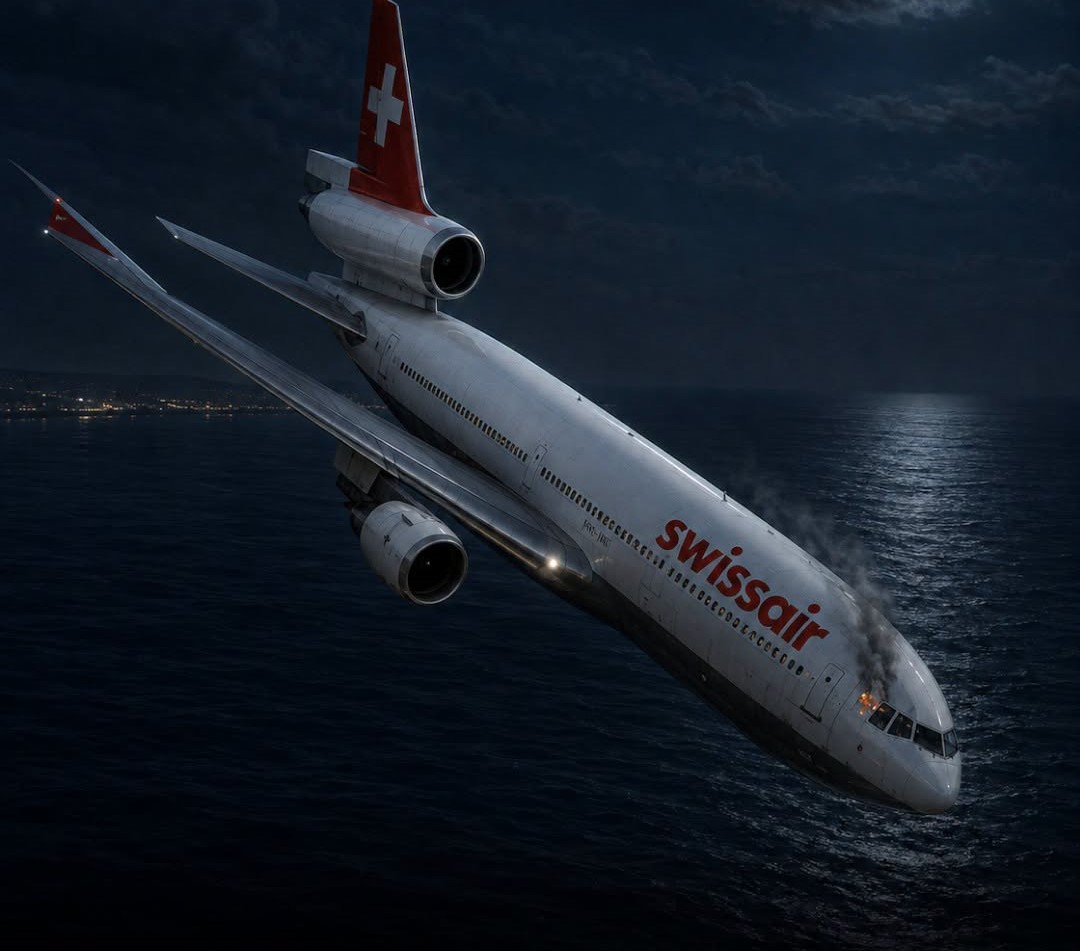
On September 2, 1998, Swissair Flight 111 departed New York’s John F. Kennedy International Airport for Geneva with 215 passengers and 14 crew members aboard.
The seven-year-old McDonnell Douglas MD-11, registered HB-IWF and named Vaud, appeared to be on a routine overnight flight. Within an hour, however, a hidden fire would turn the aircraft into one of Canada’s deadliest aviation disasters.
At about 1:10 UTC, roughly 52 minutes after takeoff, the pilots noticed an unusual smell in the cockpit. Soon afterward, smoke became visible.
The crew initially believed the problem was coming from the aircraft’s air-conditioning system, because there was no obvious indication that a major fire was developing above the cockpit ceiling.
At 1:14 UTC, the pilots contacted Moncton air traffic control with a “Pan Pan” call, reporting smoke and requesting a diversion.
They initially mentioned Boston, but Halifax was much closer and became their destination. The crew began descending and prepared for an emergency landing.
The critical problem was that the pilots did not know where the fire actually was. It was spreading above the ceiling in the forward portion of the aircraft, largely hidden from view.
As the crew worked through their smoke and fumes procedures, the fire continued consuming materials in the overhead area.
The situation deteriorated extraordinarily quickly. At about 1:20 UTC, the crew decided to dump fuel before landing. Several minutes later, they requested that the aircraft be flown manually. At 1:24:42, both pilots declared an emergency.
Less than a minute later, the aircraft’s flight data recorder began registering a rapid succession of system failures. The final radio communication was received at approximately 1:25 UTC. The recorders stopped shortly afterward.
At 1:31:18 UTC, only about 20 minutes after the first unusual smell was detected, Flight 111 slammed into the Atlantic Ocean approximately 5 nautical miles southwest of Peggy’s Cove, Nova Scotia. The MD-11 was destroyed by the impact, and all 229 people aboard were killed. There were no survivors.
The aftermath became one of the largest and most painstaking aviation investigations in Canadian history. Investigators recovered approximately 98 percent of the aircraft by weight, eventually reconstructing large portions of the wreckage on shore. The recovery operation continued for about 13 months, while the overall investigation took more than four years.
The investigation ultimately revealed that the disaster was caused by an in-flight fire that most likely began with an electrical arcing event above the ceiling near the rear wall of the cockpit.
Investigators found evidence involving wiring associated with the aircraft’s in-flight entertainment network, which had been installed relatively recently. However, the entertainment system itself was not determined to be the sole cause of the accident.
What made the fire catastrophic was the material surrounding the wiring. The electrical arcing ignited metallized polyethylene terephthalate, or MPET, covering used on thermal-acoustic insulation blankets. The flames then spread rapidly across other combustible materials, including foams, adhesives, tapes, fasteners and insulation-cover materials.
The Transportation Safety Board of Canada concluded that existing aircraft certification standards had allowed materials capable of sustaining and propagating a fire. The crew therefore faced a fire that could spread rapidly through areas they could not see or effectively reach. The investigation led to major safety recommendations concerning insulation flammability, aircraft firefighting, circuit-breaker procedures and other aspects of emergency response.
Swissair Flight 111 became a grim reminder that an apparently minor smell and a small amount of smoke can conceal a rapidly developing aircraft fire. The crash was not simply the result of a single failed component; it exposed how wiring, combustible materials, fire detection, cockpit procedures and certification standards could combine to turn a hidden fire into an uncontrollable emergency within minutes.