
On August 31, 1986, Aeroméxico Flight 498 was approaching Los Angeles when a routine arrival suddenly became one of the deadliest aviation accidents in Southern California.
The McDonnell Douglas DC-9-32, carrying 58 passengers and six crew members, was descending toward Los Angeles International Airport after flying from Mexico City via several stops.
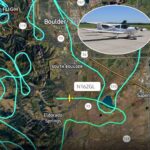
At almost exactly the same time, a small Piper PA-28-181 Archer had departed Torrance Airport for Big Bear with a pilot and two passengers aboard.
The Piper was flying under visual flight rules and was supposed to remain clear of the heavily controlled Los Angeles Terminal Control Area. Instead, it inadvertently climbed into the protected airspace while Flight 498 was being guided toward LAX under radar control.
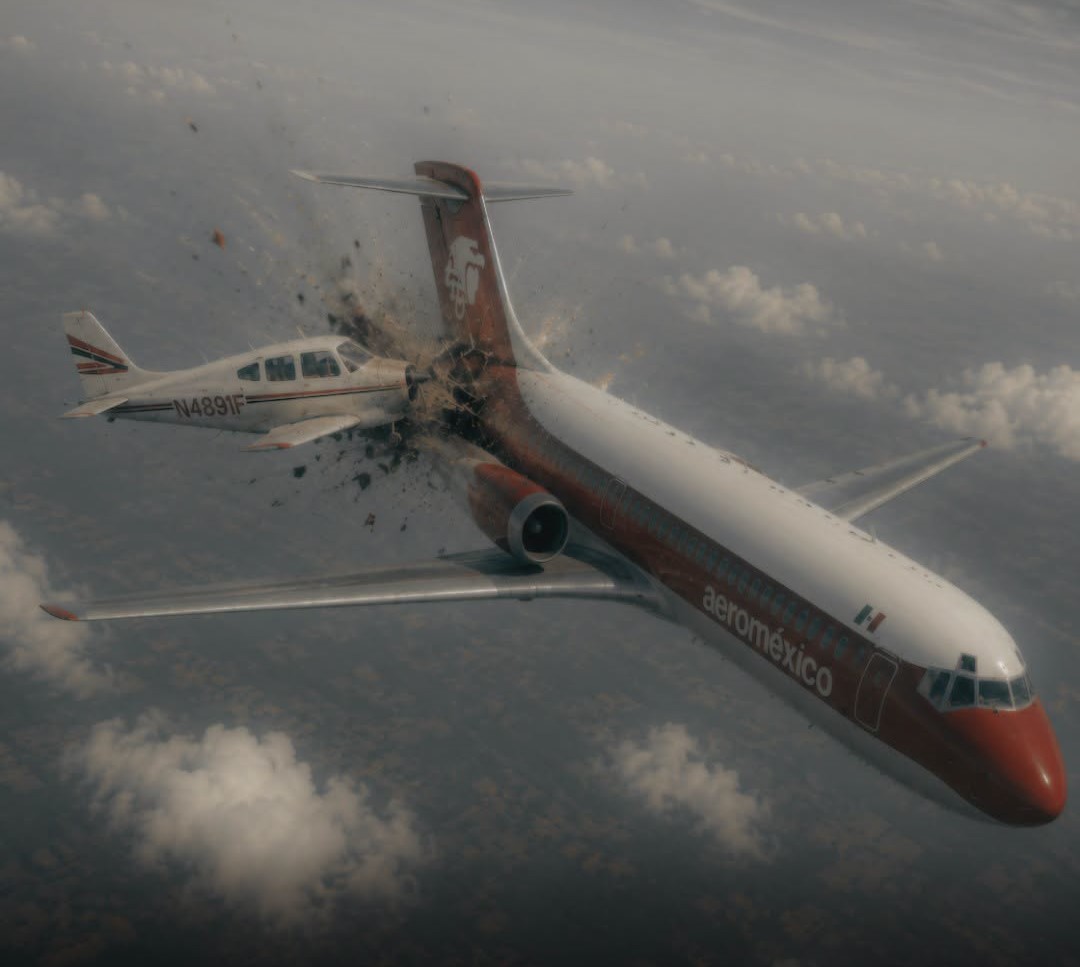
At about 11:52 a.m., over the city of Cerritos, the two aircraft converged at roughly 6,560 feet. The Piper struck the DC-9 near its tail, tearing away critical portions of the jet’s horizontal and vertical stabilizers.
The impact was catastrophic. The Piper was destroyed and entered an uncontrolled descent, eventually crashing onto the grounds of Cerritos Elementary School. The DC-9, meanwhile, lost major portions of its tail and rolled sharply to the right before plunging into a residential neighborhood.
The resulting impact and fire destroyed several homes and damaged others. All 64 people aboard the DC-9 died, as did all three occupants of the Piper. Fifteen people on the ground were also killed, bringing the total death toll to 82. Eight people on the ground were injured.
The investigation revealed that this was not simply a case of two pilots failing to see each other. The Piper had entered the Los Angeles Terminal Control Area without the required clearance and was not in radio contact with air traffic control. Its transponder did not provide Mode C altitude information.
At the same time, the Los Angeles radar system had important limitations: the controller did not perceive the Piper’s presence clearly enough to issue a traffic warning, and the facility lacked an automatic conflict-alert system that could have warned controllers about the converging aircraft.
Investigators also found that the controller was dealing with another unauthorized aircraft entering the same controlled airspace, adding to the workload. Although both aircraft were technically within visual range, neither crew saw the other in time to take evasive action.
The NTSB ultimately identified the limitations of the air traffic control system in providing collision protection as the probable cause, with the Piper’s unauthorized entry into the controlled airspace and the limitations of the “see and avoid” concept listed as contributing factors.
The accident had consequences far beyond Cerritos. The tragedy exposed weaknesses in America’s system for separating fast commercial jets from smaller general-aviation aircraft. In its aftermath, regulators moved toward requiring altitude-reporting Mode C transponders in increasingly busy airspace and mandated traffic collision avoidance systems for large commercial aircraft.
The accident became a powerful lesson that simply expecting pilots to see and avoid one another was not enough in increasingly crowded skies.