

Airlink’s Jaw-Dropping Stadium Flyover: Incredible Precision or Unnecessary Risk?
It looked like something from an action movie.
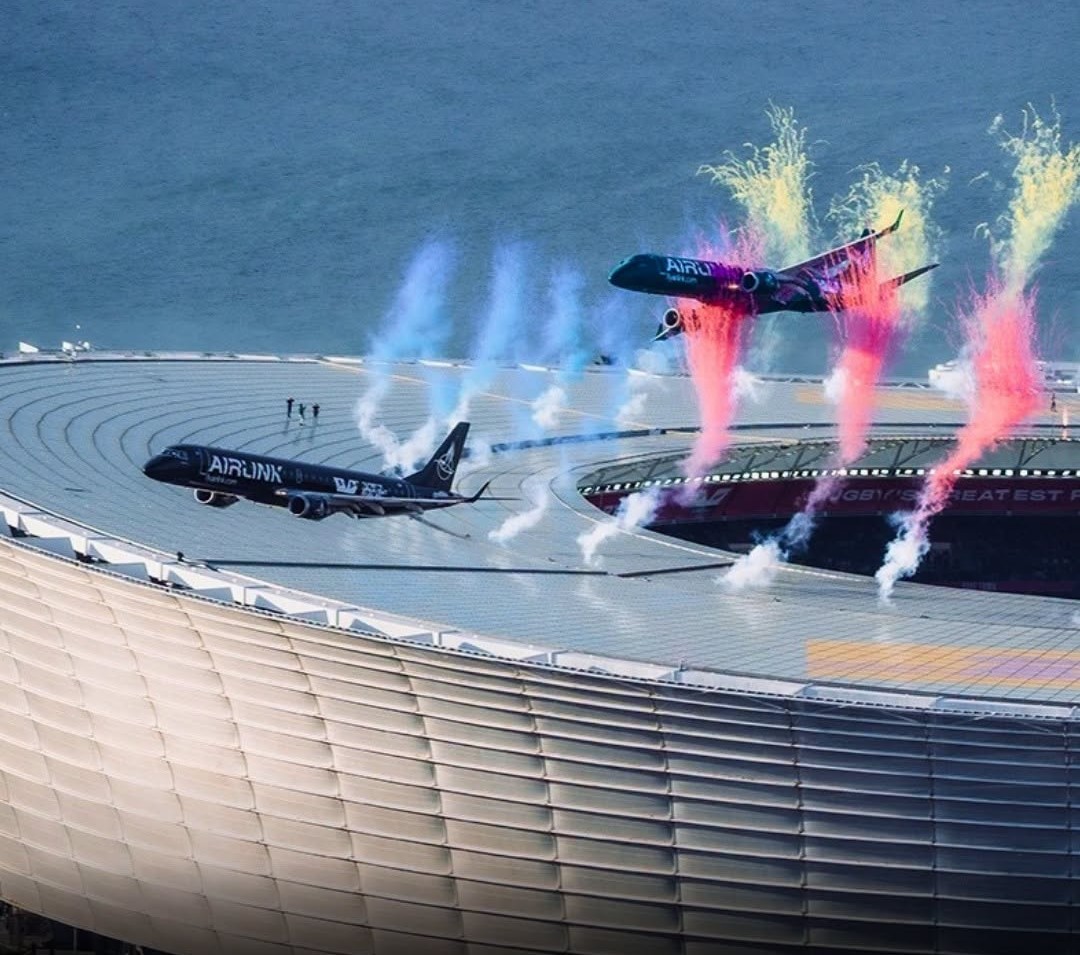
Just moments before South Africa faced New Zealand at Cape Town’s DHL Stadium on August 30, two Airlink Embraer passenger jets thundered over the packed stadium in formation. One wore Springbok green, the other represented the All Blacks, while pyrotechnics were firing as the aircraft swept across the venue.
Then the videos appeared online — and aviation enthusiasts around the world started asking the same question:
How low were those aircraft actually flying?
Flight-tracking data suggested that the lead aircraft passed approximately 41–46 feet (12.5–14 metres) above the top of the stadium. That is an astonishingly small vertical separation for a commercial regional jet travelling at around 150 knots, or roughly 280 km/h.
From some camera angles, the aircraft appeared almost close enough to touch the stadium roof. The changing perspective and pitch of the aircraft made the scene look even more dramatic, but the tracking data nevertheless indicated that this was an exceptionally low flypast.
So, was it actually dangerous?
The answer is more complicated than the viral videos suggest.
Airlink said the flyover was not an improvised stunt. It was carefully planned and rehearsed, with guidance and approval from South African aviation authorities and air traffic services. The airline also said both aircraft were operated by highly experienced crews, with three senior captains aboard each aircraft serving in commander, co-pilot and safety/technical roles.
Airlink further stated that recorded flight data showed the aircraft remained within the altitude and speed limits approved for the display.
But that doesn’t necessarily mean there was no risk.
The concern raised by aviation professionals wasn’t necessarily that the pilots lacked skill. The issue was what happens if something unexpected occurs when an airliner is operating only a few dozen feet above a massive stadium filled with people.
At normal cruising altitude, pilots have enormous amounts of time and space to respond to an engine problem, human error or another unexpected event.
At roughly 40 feet above a stadium roof, those options become extremely limited.
And that’s the important distinction: a maneuver can be carefully planned, legally authorised and successfully completed — while still having a smaller safety margin than aviation professionals would ideally like.
Some aviation experts considered the flyover technically impressive and within an approved sequence, while others questioned whether the aircraft really needed to be flown so low when a higher pass could have produced almost the same spectacular effect with a greater margin for error.
There is also an important point about the viral footage: photographs and videos can exaggerate apparent proximity because of camera angles, lenses and the aircraft’s pitch. The estimated 41–46-foot separation is based on flight-tracking information rather than a direct measurement between the aircraft and stadium roof.
And this wasn’t the first spectacular rugby flyover in South Africa.
The tradition goes back to the legendary 1995 Rugby World Cup final, when a South African Airways Boeing 747 flew low over Ellis Park before South Africa played New Zealand. That moment became one of the most iconic images in South African sporting history and was later recreated in the film Invictus.
But modern aviation has also become increasingly focused on the concept of safety margins — not simply whether something can be done, but whether it needs to be done with such little room for error.
That is why this Airlink flyover has divided aviation enthusiasts and professionals.
To spectators, it was spectacular.
To the pilots flying it, it was a carefully rehearsed demonstration of precision.
To critics, the question is simpler: if the same visual effect could have been achieved by flying higher, why accept the additional risk?
Airlink has offered the aircraft’s recorded data to the South African Civil Aviation Authority for independent review.
So perhaps the fairest conclusion is this:
It doesn’t appear to have been a reckless, uncontrolled stunt. There was planning, rehearsal, experienced crews, regulatory involvement and an authorised flight profile.
But it was undeniably an aggressive low-level display over a stadium containing tens of thousands of people.
And in aviation, the fact that something went perfectly does not automatically prove that the risk was optimal.
The real test will be what the regulator’s review of the flight data concludes.
One thing is certain, though: Airlink’s flyover has once again shown why South Africa’s rugby traditions can be just as dramatic in the sky as they are on the field.