
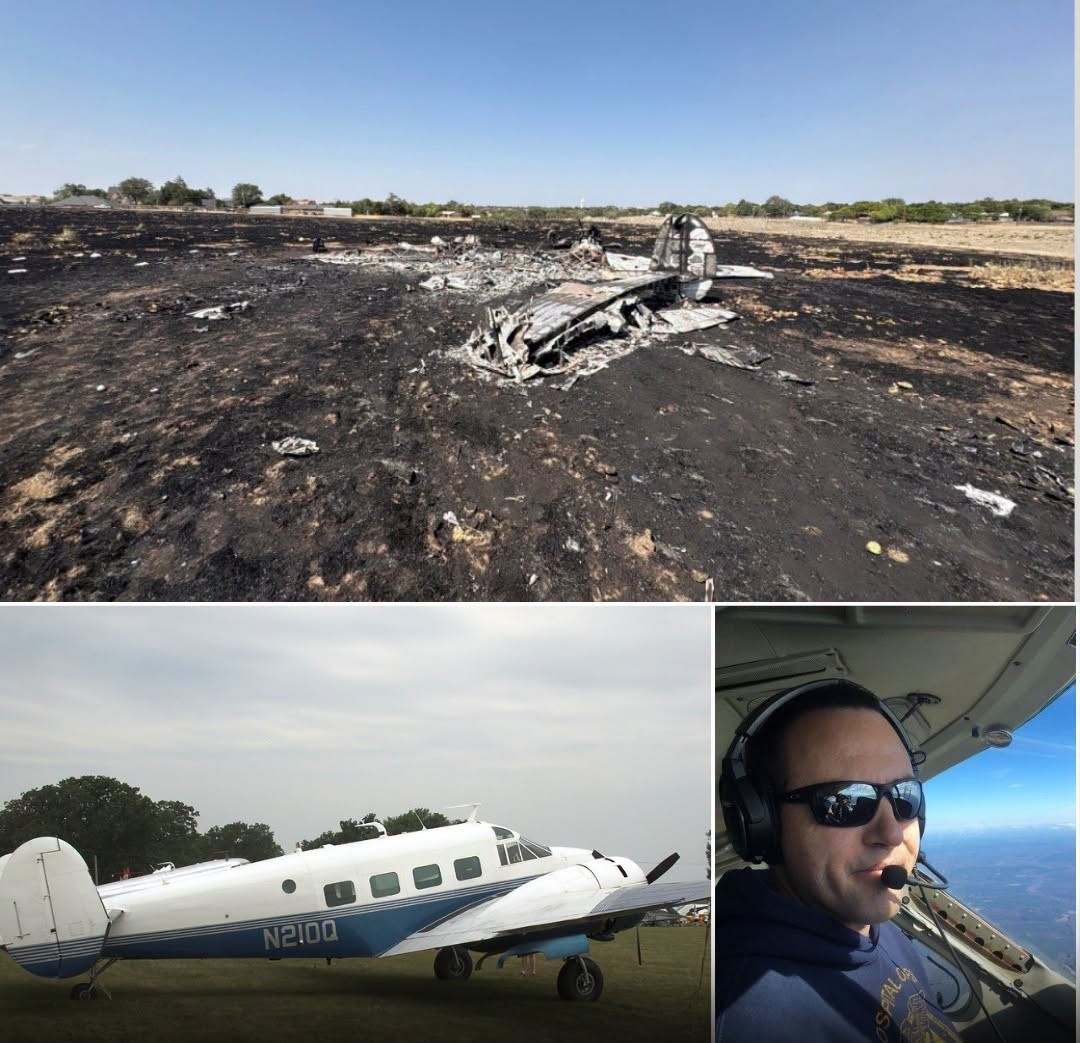
The National Transportation Safety Board (NTSB) has released its preliminary report into the August 2 crash of a Beech E18S near Guymon, Oklahoma, which killed the pilot.
According to the report, the aircraft had just departed Guymon Municipal Airport at about 4:06 p.m. after taking on 211.7 gallons of fuel and adding oil to both engines. The pilot announced that he was departing to the east.
But shortly after takeoff, witnesses saw the aircraft make a left bank. It then turned toward the north while descending in a nose-low, left-wing-low attitude.
The aircraft eventually impacted a grass-covered field in a wings-level, flat-pitch attitude and came to rest about 80 feet from the initial impact point. A post-impact fire consumed most of the fuselage and severely damaged the wings and tail.
One of the most significant findings so far: investigators found no evidence of a pre-impact flight-control malfunction or failure that would have prevented normal operation. Both engines were separated from the airframe but remained near the main wreckage, while the propellers showed varying degrees of bending, twisting, scratching and polishing.
The NTSB also has multiple security-camera recordings of the accident sequence. The footage has been sent to its Vehicle Performance Division for further analysis, which could help investigators determine exactly how the aircraft moved during its final moments.
The pilot was highly experienced, reporting approximately 12,000 hours of flight time and holding extensive airplane and helicopter qualifications. Weather at the time was clear with 10-mile visibility, no ceiling and winds of about 9 knots.
However, the preliminary report does not yet identify a probable cause.
The investigation is continuing, with the wreckage recovered for further examination and the security footage undergoing detailed analysis.
The question investigators are now trying to answer: Why did the aircraft enter the descending turn shortly after takeoff?