
On 29 August 1960, Air France Flight 343 was approaching Dakar, Senegal, on a routine international flight from Paris to Abidjan. The Lockheed L-1049G Super Constellation, registration F-BHBC, carried 55 passengers and eight crew members.
Within minutes, the aircraft would disappear into the Atlantic Ocean, killing everyone aboard. What made the tragedy particularly haunting was that the crew had already abandoned one landing attempt and had been offered an instrument approach, yet the aircraft made another approach into deteriorating weather before entering a violent rain squall. The exact technical cause of the crash was never conclusively established.
Flight 343 was operating a scheduled service from Paris to Abidjan, with planned stops at Dakar and Monrovia. The aircraft was a Lockheed L-1049G Super Constellation, one of the iconic four-engine airliners of the piston-engine era. F-BHBC had first flown in 1955 and had accumulated approximately 16,417 flight hours by the time of the accident.
As the aircraft approached Yoff Airport in Dakar shortly before sunrise, conditions were far from ideal. The area was experiencing low overcast, rapidly changing visibility, rain squalls and thunderstorms. Cloud cover was reported at roughly 2,000 to 3,000 feet. These conditions made visual navigation and landing considerably more difficult.
The crew initially attempted to land on Runway 01. The approach was abandoned, however, as the weather prevented a satisfactory landing. Air traffic control offered the crew the possibility of making an instrument landing on Runway 30. The crew declined that option and instead entered a holding pattern, apparently hoping that the weather would improve enough to permit another visual approach.
Shortly after 06:41, Flight 343 began another approach toward Runway 01. The decision placed the aircraft back into an environment in which visibility was changing rapidly and heavy rain and thunderstorms were present. At approximately 06:47, the second landing attempt was also abandoned. The Super Constellation overflew the airport, and the pilot reported to air traffic control that the aircraft was at about 1,000 feet.
Then came the final and most mysterious part of the flight.
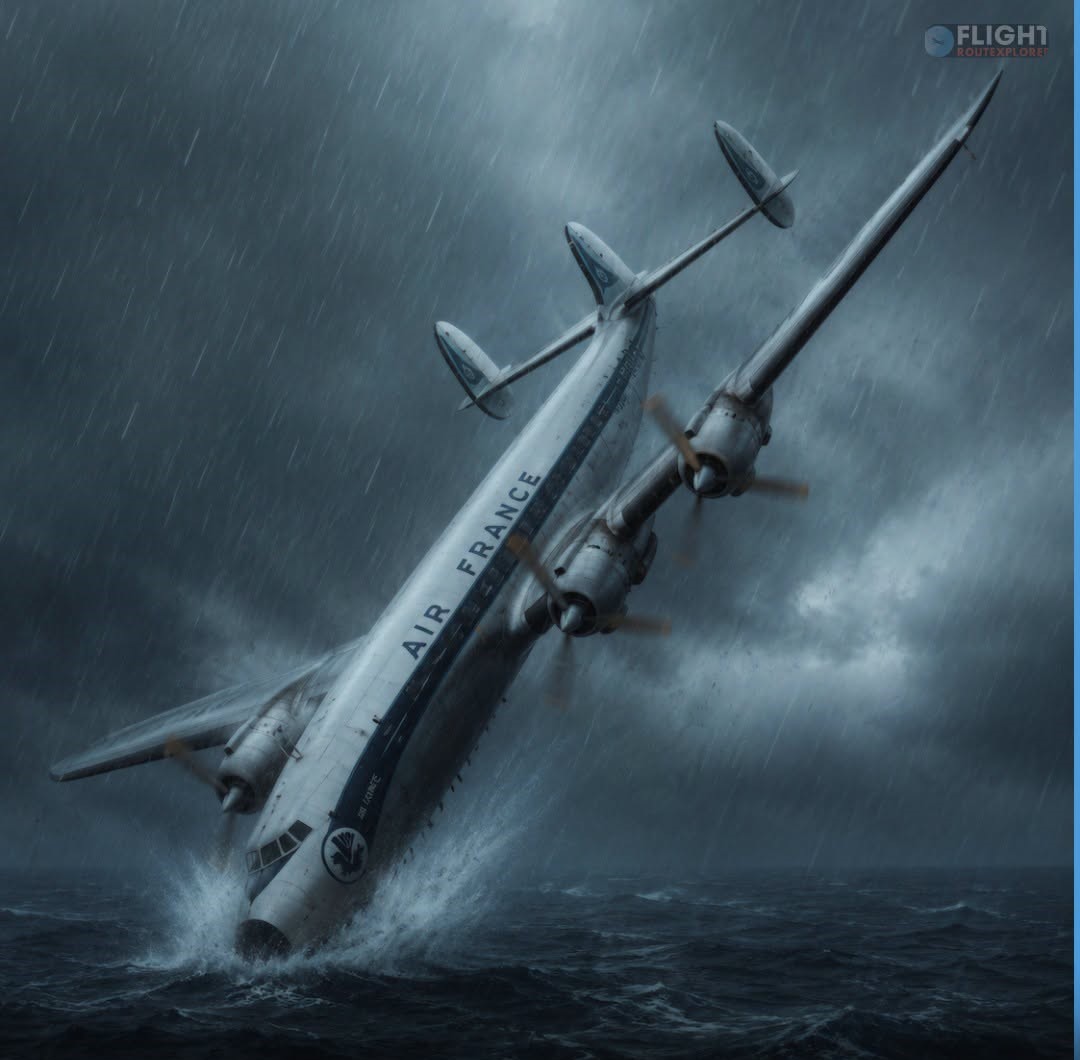
Shortly after the aircraft passed over the airport, it entered a rain squall. Somewhere in the heavy weather, the crew lost control or became unable to maintain the aircraft’s intended flight path. The Super Constellation descended toward the Atlantic and struck the water approximately one mile offshore, about 2.4 kilometres from the Les Mamelles Lighthouse. The aircraft hit the ocean at a steep angle and was believed to have been banking to the right at the moment of impact.
There was no chance of survival. All 55 passengers and eight crew members were killed, making a total of 63 fatalities. Among those aboard was David Diop, the prominent French West African poet and writer whose death added a significant cultural dimension to the tragedy.
The aircraft came to rest in approximately 130 feet, or 40 metres, of water. Recovery operations were mounted, and most of the victims’ bodies were eventually recovered. However, the salvage effort was severely limited. Only about 20 percent of the aircraft wreckage could be recovered and brought ashore. The limited amount of physical evidence made the investigators’ task exceptionally difficult.
The official investigation ultimately failed to identify a single definitive cause for the crash. Instead, investigators considered several possibilities. One possibility was a structural failure or a loss of control brought about by severe turbulence. Another was a sensory illusion that could have caused the crew to misjudge the aircraft’s attitude or altitude, particularly while flying through heavy rain and poor visual conditions.
Investigators also considered the possibility that the flight crew had been distracted, potentially by lightning, during the crucial moments after entering the rain squall. Instrument problems were another possibility. A malfunctioning airspeed indicator or altimeter, or an incorrect interpretation of the instruments, could potentially have left the crew with an inaccurate understanding of the aircraft’s speed or altitude.
None of these theories could be conclusively proven. The wreckage was largely inaccessible beneath the sea, and the investigation lacked the kind of flight data recorders and cockpit voice recorders that would later become indispensable tools in accident investigations. Consequently, the exact sequence of events inside the cockpit during the final moments remained unknown.
There was, however, another important revelation that emerged not from the technical investigation itself but from subsequent legal proceedings.
Families of the victims pursued compensation claims against Air France under the Warsaw Convention. One of the cases involved the widow of David Diop. During the legal proceedings, the courts examined the conduct of the flight crew and the circumstances surrounding the attempted landing.
In 1964, the Tribunal de grande instance de Seine considered the Diop case, which was subsequently appealed to the Court of Appeal of Paris. The courts awarded compensation at the applicable basic level but did not find Air France itself particularly negligent. However, the proceedings brought attention to the pilot’s previous disciplinary history. He had reportedly been punished by Air France for recklessness before the accident.
The court concluded that the pilot’s decision to continue attempting a landing in bad weather without using the available instruments amounted to wilful misconduct. This was a significant legal finding because it placed emphasis on the pilot’s decision-making rather than establishing a definitive mechanical cause for the crash.
That distinction is important. The official accident investigation did not say that the crash was definitively caused by pilot error. It left the technical cause undetermined and listed several possible explanations. The later court proceedings, however, reached a finding concerning the pilot’s conduct, particularly his decision to continue attempting a visual landing despite poor weather and the availability of an instrument approach.
The tragedy therefore remains an unusual case in aviation history: the aircraft’s final moments can be reconstructed only partially, the physical wreckage was largely lost beneath the Atlantic, and the official investigation could not establish one definitive technical cause. Yet the subsequent legal proceedings provided a separate conclusion about the pilot’s actions.
Air France Flight 343 was ultimately a disaster born in a dangerous combination of rapidly changing weather, limited visibility, repeated landing attempts and uncertainty about what happened inside the cockpit during the final seconds. The aircraft had already abandoned one approach, declined an available instrument landing opportunity and entered another approach before the weather deteriorated further. After the second missed approach, it entered a rain squall and crashed into the ocean at a steep angle.
Sixty-three people lost their lives on 29 August 1960. The crash of Flight 343 remains a reminder of how quickly a seemingly routine landing can become catastrophic when severe weather, human decision-making and limited information converge. More than six decades later, the precise technical chain that brought the Super Constellation down remains unresolved, leaving the final moments of Air France Flight 343 partly hidden beneath the waters off Dakar.