
On July 25, 2000, Air France Flight 4590, a Concorde supersonic airliner, crashed just moments after takeoff from Paris Charles de Gaulle Airport, becoming the only fatal accident involving the legendary Concorde during its 27 years of passenger service.
In a tragic chain of events lasting barely more than a minute, all 109 people on board and four people on the ground lost their lives. The curious detail that still astonishes aviation experts is that the disaster began with a 17-inch titanium strip that had fallen from another aircraft only minutes earlier.
Air France Flight 4590 was operating a charter service from Paris to New York’s John F. Kennedy International Airport. The passengers, most of them German tourists, were beginning a luxury cruise aboard the MS Deutschland. The aircraft, registration F-BTSC, taxied normally and lined up on Runway 26R for departure.
Just five minutes before the Concorde began its takeoff roll, a Continental Airlines McDonnell Douglas DC-10 departing from the same runway unknowingly lost a titanium wear strip from one of its engine cowlings. The metal strip remained on the runway, unnoticed by airport personnel. Investigators later determined that the replacement strip had been improperly manufactured from titanium instead of the specified stainless steel.
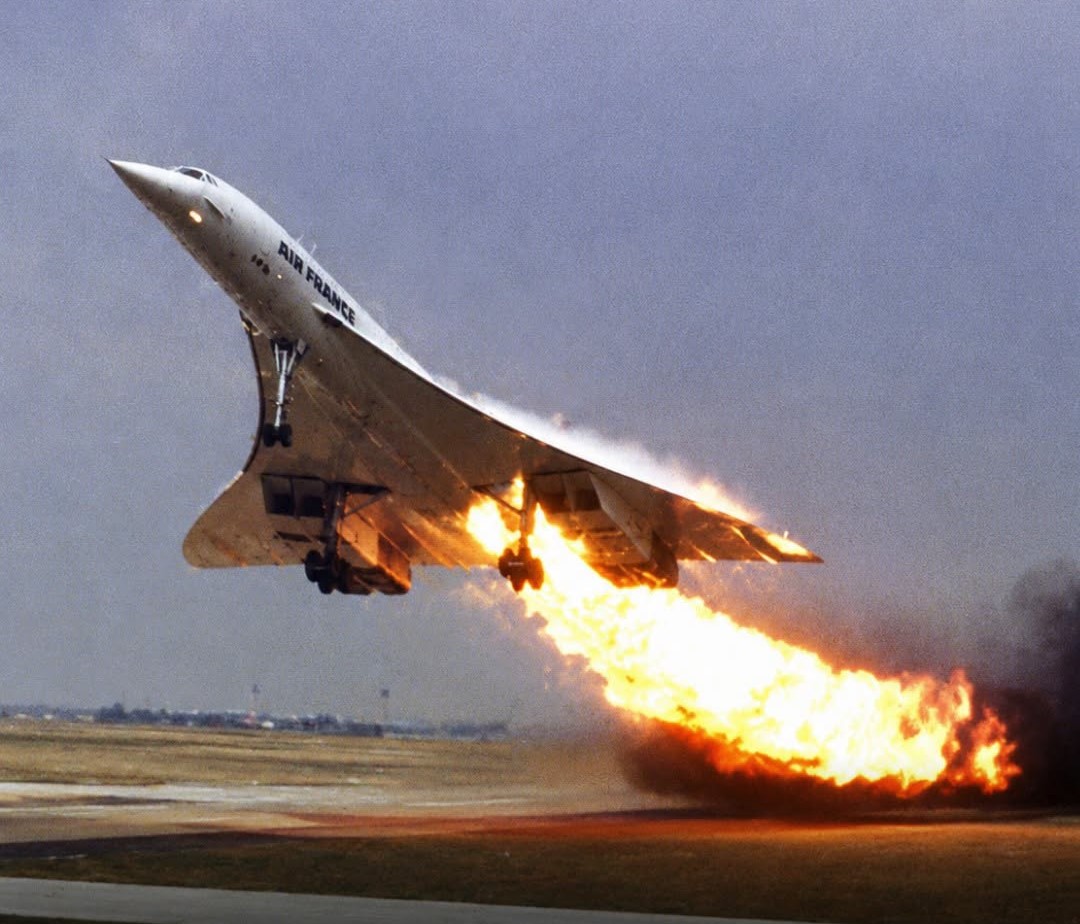
At approximately 16:42 local time, as the Concorde accelerated through around 300 km/h (185 mph), its left main landing gear rolled directly over the titanium strip. The sharp metal sliced through one of the aircraft’s tires, causing it to explode violently. Large pieces of rubber, weighing several kilograms, were hurled upward at tremendous speed into the underside of the aircraft’s left wing.
For many years, it was widely believed that the tire debris directly punctured the fuel tank. However, the official investigation revealed a more complex mechanism. The tire fragments struck the wing with such force that they generated a powerful hydrodynamic pressure wave inside Fuel Tank No. 5.
This pressure surge caused the tank to rupture from within at one of its weakest structural points, releasing a massive quantity of fuel almost instantly. This finding became one of the most significant revelations of the investigation because it demonstrated that the fuel tank had not been pierced directly by the tire fragments.
Almost immediately, the escaping fuel ignited, most likely due to an electrical arc created by damaged wiring in the landing gear bay or contact with extremely hot engine components. A massive fire erupted beneath the left wing and rapidly spread behind the aircraft. The flames were visible to air traffic controllers, who immediately warned the crew that the aircraft was on fire.
By this point, the Concorde had already passed V1, the decision speed beyond which a takeoff could no longer be safely rejected. The pilots had no choice but to continue the departure. The aircraft lifted off, but almost immediately suffered severe performance problems.
Engine No. 2 experienced significant power loss and fire warnings, forcing the crew to shut it down. Engine No. 1 also suffered repeated power surges and loss of thrust. Meanwhile, damage to the landing gear prevented it from retracting, creating enormous aerodynamic drag. With one engine shut down, another producing reduced thrust, landing gear extended, and fire damaging the aircraft’s systems, the Concorde simply could not accelerate or climb normally.
The crew attempted to divert to nearby Le Bourget Airport, but the aircraft never gained sufficient altitude. It climbed to only about 200 feet before its speed began decreasing. The left wing continued burning, structural damage increased, and the aircraft rolled left before the pilots lost control.
Just 77 seconds after becoming airborne, the Concorde crashed into the Hôtelissimo Les Relais Bleus hotel in Gonesse, approximately 10 kilometers from Charles de Gaulle Airport. The impact and resulting fire destroyed the aircraft completely.
The crash killed all 100 passengers and nine crew members aboard. Four people inside the hotel also lost their lives, while several others on the ground were injured. It remains the deadliest accident involving the Concorde and the only fatal crash in the aircraft’s operational history.
The accident had an immediate and profound impact on supersonic passenger travel. Within weeks, aviation authorities in France and the United Kingdom grounded every Concorde in service. Engineers spent more than a year redesigning critical systems before the fleet was allowed to return to service.
The modifications included installing Kevlar liners inside vulnerable fuel tanks, fitting stronger, burst-resistant tires, improving electrical wiring protection, and reinforcing areas around the landing gear to better withstand tire failures. These changes significantly improved the aircraft’s safety margins.
Although the Concorde returned to commercial operations in late 2001, passenger confidence never fully recovered. The aviation industry also suffered a dramatic downturn after the September 11 attacks, reducing demand for premium supersonic travel. Combined with rising maintenance costs and the aging fleet, Air France and British Airways jointly retired the Concorde in 2003, bringing the era of commercial supersonic passenger travel to an end.
The official investigation concluded that the primary cause of the accident was the titanium wear strip left on the runway by the Continental DC-10. The strip caused the Concorde’s tire to burst, which generated high-energy debris that produced a hydrodynamic pressure wave inside the wing fuel tank. The resulting rupture caused a massive fuel leak that ignited, leading to engine failures, inability to retract the landing gear, loss of thrust, and ultimately the loss of control. Investigators also noted that earlier Concorde incidents involving tire failures had highlighted vulnerabilities in the aircraft’s design, but none had previously produced such catastrophic fuel tank damage. The Flight 4590 accident fundamentally changed aircraft certification standards for tire debris resistance and fuel tank protection across the aviation industry.