
On July 23, 1983, Air Canada Flight 143 turned what should have been one of aviation’s deadliest disasters into one of its greatest survival stories. The Boeing 767-200, carrying 61 passengers and eight crew members, departed Montreal for Edmonton with a scheduled stop in Ottawa.
What nobody on board realized was that the aircraft had been loaded with barely half the fuel it actually needed. Hours later, both engines would shut down in flight, leaving the modern jetliner completely powerless at 41,000 feet. Against all odds, the aircraft would glide safely to an abandoned Royal Canadian Air Force base at Gimli, Manitoba, earning the unforgettable nickname “The Gimli Glider.”
The chain of events began even before the flight departed. The aircraft’s Fuel Quantity Indication System (FQIS), which electronically measures fuel on board, had developed a fault during earlier operations.
Maintenance personnel attempted troubleshooting, but confusion during testing left the aircraft without a functioning fuel quantity display. Under certain conditions, the aircraft could legally fly with a partially failed system if fuel was manually verified.
However, after a series of maintenance misunderstandings, both channels of the system became unavailable, forcing crews to rely entirely on manual measurements using dripsticks inserted into the fuel tanks.
The Boeing 767 was one of Air Canada’s newest aircraft and among the first in its fleet to use metric measurements. Most of the airline’s older aircraft still used imperial units. After manually measuring the fuel volume in litres, the pilots and ground crew had to convert that volume into kilograms because the aircraft’s flight management computer required fuel weight rather than fuel volume.
Unfortunately, they mistakenly used a conversion factor expressed in pounds per litre instead of kilograms per litre. The arithmetic itself was correct, but the wrong unit conversion meant they believed there was far more fuel on board than actually existed. Instead of loading approximately 22,300 kilograms of fuel required for the journey, the aircraft departed with only about 10,100 kilograms—less than half of what was needed. The same incorrect calculation was repeated during the stop in Ottawa, reinforcing the mistake instead of catching it.
After leaving Ottawa and climbing to cruise altitude, the first indication of trouble came when warning messages appeared in the cockpit showing low fuel pressure in the left engine. Moments later, the left engine flamed out. The crew immediately began diversion procedures, but before they could reach an airport, the right engine also lost power. Suddenly, the Boeing 767 became a powerless glider. Electrical power was largely lost until the aircraft’s Ram Air Turbine automatically deployed beneath the fuselage, providing enough hydraulic and electrical power to keep essential flight controls functioning.
Captain Robert Pearson happened to be an experienced glider pilot, a skill that proved invaluable. First Officer Maurice Quintal, who had previously served at the former Royal Canadian Air Force base at Gimli, suggested attempting an emergency landing there. Unknown to the crew, part of the former military runway had been converted into the Gimli Motorsports Park, and a family racing event was underway. Spectators and vehicles occupied portions of the old runway as the silent Boeing descended toward them without engine power.
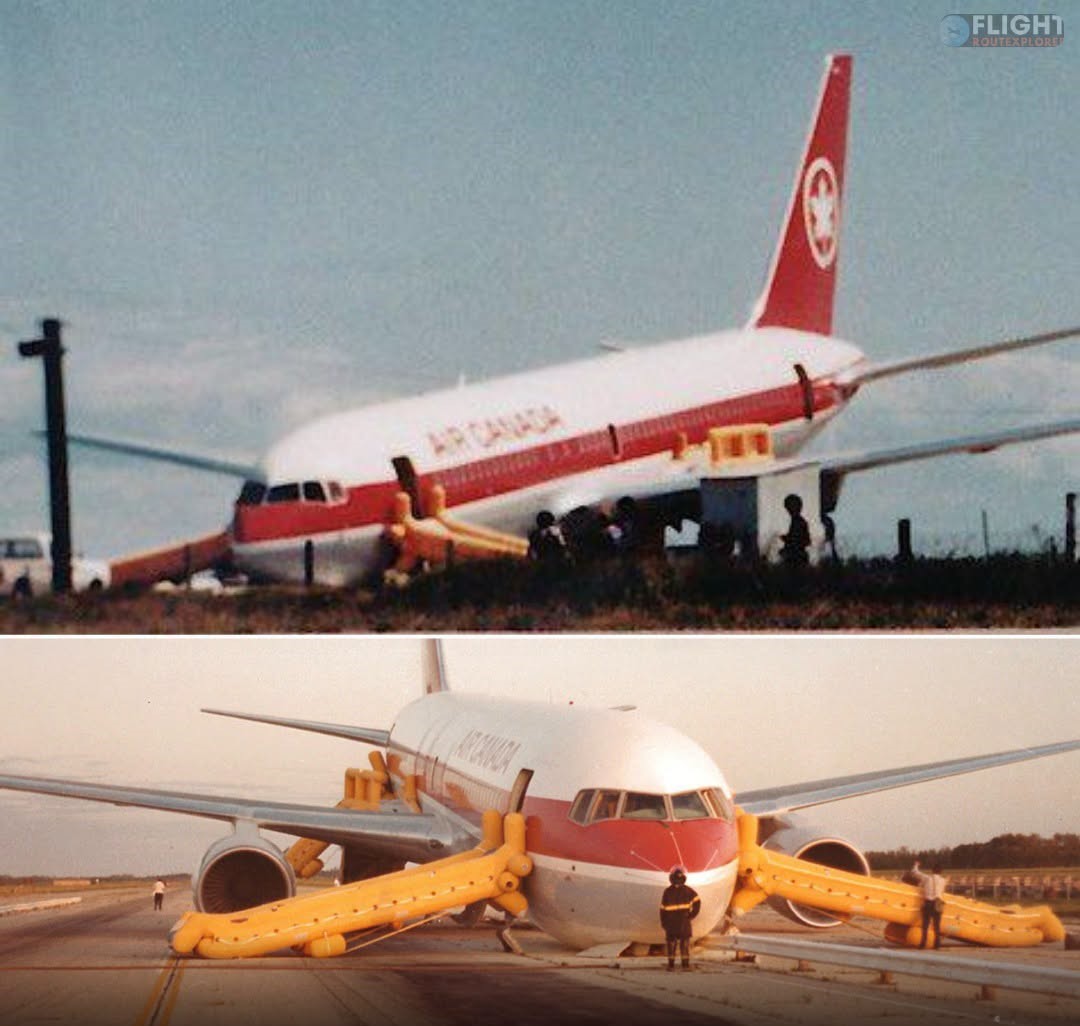
Because the aircraft was approaching too high and too fast, Captain Pearson performed a forward slip—a maneuver commonly used in gliders but rarely seen in large commercial jets—to rapidly lose altitude without excessive speed. As the aircraft neared touchdown, the nose landing gear failed to lock properly and collapsed upon landing. The nose scraped along the runway, creating sparks while the collapsed gear actually helped slow the aircraft. The plane came to a stop just short of spectators gathered near the racecourse. Emergency slides were deployed, and all 69 people on board evacuated safely. Ten occupants suffered minor injuries, mainly during the evacuation, but remarkably there were no fatalities either on board or on the ground.
The aircraft sustained relatively minor structural damage despite the dramatic landing. Temporary repairs were carried out at Gimli before the Boeing 767 was flown to Winnipeg for more extensive maintenance. After being fully repaired, the aircraft returned to commercial service and continued flying passengers for Air Canada for another 25 years before being retired in 2008. Its extraordinary survival story became one of the most famous examples of successful crew resource management and airmanship in aviation history.
The official investigation concluded that the accident was not caused by a single mistake but by a cascade of technical failures, maintenance errors, unclear procedures, and human factors. Investigators found that the defective fuel indication system, maintenance misunderstandings, inadequate assignment of fueling responsibilities, and confusion between imperial and metric measurements all combined to create the conditions for the accident. The Board of Inquiry criticized Air Canada for insufficient procedures and training during Canada’s transition to the metric system and for failing to clearly define who was responsible for manually calculating fuel loads on the new two-crew Boeing 767 fleet after the removal of the flight engineer position.
The investigation led to significant changes across the airline. Air Canada introduced clearer fueling procedures, improved crew training for manual fuel calculations, strengthened maintenance practices, and accelerated the standardization of measurement units across its fleet to eliminate the risks of mixing imperial and metric systems. The Gimli Glider remains a classic case study taught to pilots, engineers, and aviation safety professionals worldwide, demonstrating how a simple unit-conversion mistake, combined with multiple organizational failures, nearly resulted in catastrophe—but was ultimately overcome through exceptional flying skill, teamwork, and calm decision-making under extreme pressure.