
On the evening of July 17, 1996, Trans World Airlines Flight 800 departed New York’s John F. Kennedy International Airport on what was supposed to be a routine international flight to Paris, France. Instead, just 12 minutes after takeoff, the Boeing 747-131 broke apart over the Atlantic Ocean near East Moriches, Long Island, becoming one of the deadliest aviation disasters in U.S. history. All 230 people on board, including 212 passengers and 18 crew members, lost their lives.
The tragedy led to one of the largest, longest, and most expensive aviation accident investigations ever conducted in the United States, fundamentally changing aircraft fuel tank safety regulations.
Flight 800 pushed back from its gate at JFK on the warm summer evening and departed at approximately 8:19 p.m. Eastern Daylight Time. The aircraft climbed normally toward its assigned cruising altitude while flying southeast over Long Island.
Weather conditions were good, and there were no indications of operational problems. The crew communicated routinely with air traffic controllers, and nothing unusual was reported from the cockpit.
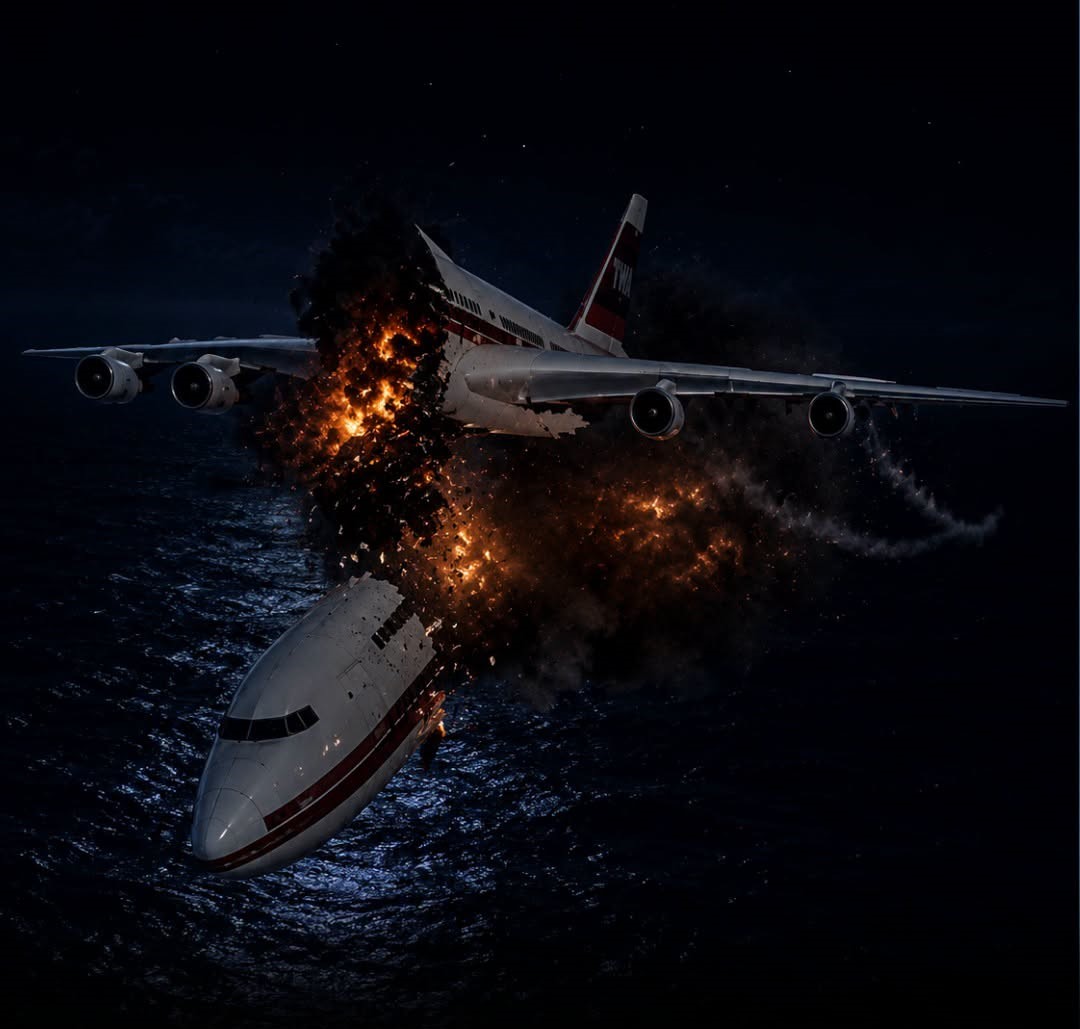
About 12 minutes into the flight, at approximately 8:31 p.m., while climbing through about 13,700 feet, a catastrophic explosion occurred inside the aircraft’s center wing fuel tank. The explosion instantly tore apart the structure surrounding the tank, causing the forward section of the aircraft, including the cockpit, to separate from the rest of the fuselage. Investigators later determined that the remaining center and aft sections of the aircraft continued climbing for several seconds due to aerodynamic forces before losing control, rolling over, and plunging into the Atlantic Ocean. This brief climb without the nose section became one of the most astonishing findings of the investigation and initially fueled widespread public confusion about what witnesses had seen.
Residents along Long Island’s south shore, boaters, and other eyewitnesses reported seeing a bright fireball in the evening sky before burning wreckage fell into the ocean. Emergency responders, the U.S. Coast Guard, U.S. Navy vessels, fishing boats, and rescue helicopters rushed to the scene. However, it quickly became clear there were no survivors. Debris was scattered across miles of the Atlantic, making recovery operations extremely challenging. Over the following months, recovery teams painstakingly retrieved aircraft wreckage, flight recorders, and victims from the seabed.
The disaster claimed the lives of people from many countries, including families, students, airline employees, and vacation travelers. Among them was English teacher Lois Van Epps, whose former students and friends remembered her as an adventurous educator who inspired generations of young people. Actor Joe Mantegna later credited Van Epps with encouraging him to pursue acting during his high school years, saying her support had a lasting impact on his career. Thirty years later, colleagues continued remembering her enthusiasm for teaching, travel, and the arts, while her name remains engraved on the TWA Flight 800 International Memorial overlooking the Atlantic near the crash site.
The investigation became one of the most exhaustive aviation inquiries ever undertaken. More than 95 percent of the aircraft’s wreckage was recovered from the ocean floor. Investigators transported thousands of pieces to a hangar in Virginia, where they reconstructed much of the Boeing 747 on a massive steel framework. The reconstruction allowed investigators to examine fracture patterns, burn marks, wiring, and structural failures in remarkable detail, helping establish the exact sequence of the aircraft’s breakup.
Because numerous eyewitnesses reported seeing what appeared to be a streak of light rising toward the aircraft, speculation immediately spread that the airplane had been struck by a missile or destroyed by a bomb. The FBI joined the investigation, conducting one of the largest criminal inquiries in U.S. history. Investigators examined the possibility of terrorism, missile strikes, and explosive devices, analyzing radar data, recovered wreckage, chemical residue, and intelligence information. After years of investigation, authorities found no evidence supporting a missile attack or onboard bomb. Investigators concluded that witness observations were consistent with the burning aircraft climbing briefly after the initial explosion rather than an object striking it.
After a four-year investigation, the National Transportation Safety Board concluded that the probable cause of the accident was an explosion of the center wing fuel tank containing a flammable mixture of fuel vapor and air. Although investigators could not determine the precise ignition source with absolute certainty, they concluded the most likely scenario involved a short circuit outside the fuel tank that allowed excessive electrical voltage to enter wiring associated with the fuel quantity indication system, igniting the flammable vapors inside the tank. The investigation also identified contributing factors, including aircraft design assumptions regarding fuel tank safety and heat generated by air-conditioning packs located beneath the center wing tank, which increased fuel vapor temperatures.
The tragedy resulted in sweeping aviation safety improvements. The Federal Aviation Administration introduced new fuel tank safety requirements, including regulations to reduce fuel tank flammability and prevent ignition sources. Airlines and aircraft manufacturers implemented wiring inspections, design modifications, improved maintenance practices, and, on many aircraft types, nitrogen inerting systems that reduce oxygen levels inside fuel tanks to make ignition far less likely. These changes have significantly improved fuel tank safety across commercial aviation fleets worldwide.
Three decades after the disaster, TWA Flight 800 remains a defining moment in aviation history. Beyond the heartbreaking loss of 230 lives, the accident transformed how engineers design aircraft fuel systems, how regulators address fuel tank flammability, and how investigators reconstruct complex accidents. The lessons learned from Flight 800 continue to influence commercial aircraft safety standards around the world, ensuring that one of aviation’s greatest tragedies led to lasting improvements in the protection of future passengers.