
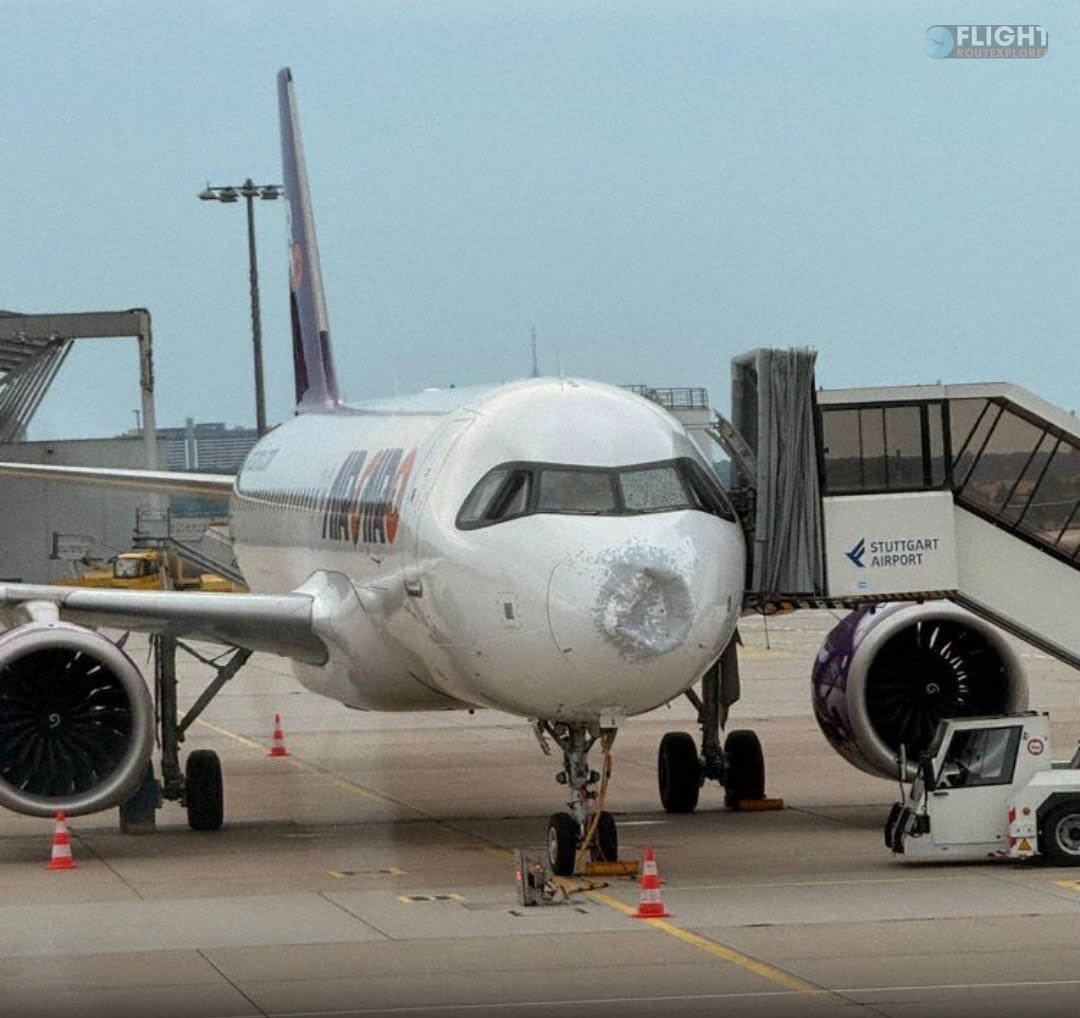
An Air Cairo Airbus A320neo (registration SU-BVN) operating Flight SM-2952 from Marsa Alam, Egypt, to Stuttgart, Germany, encountered hail while approaching Stuttgart Airport on July 16, 2026. Despite the severe weather, the crew landed the aircraft safely on Runway 07, and no injuries were reported.
The aircraft has remained grounded in Stuttgart for detailed inspections, while a replacement Airbus A320 (SU-BUR) was flown in to operate the return service, resulting in a delay of approximately 12.5 hours.
The incident highlights one of aviation’s most dangerous weather hazards—hail. Hail forms inside powerful thunderstorm clouds when strong updrafts repeatedly carry water droplets above the freezing level, where they freeze and grow into layers of ice before becoming heavy enough to fall. While modern airliners are designed to withstand harsh weather, large hailstones striking an aircraft at high speed can crack cockpit windshields, dent the nose radome, damage weather radar systems, wing leading edges, sensors, lights, and even engines if ingested. Even after a safe landing, aircraft exposed to hail often require extensive inspections and repairs before returning to service.
Pilots use onboard weather radar and air traffic control guidance to avoid thunderstorms, but hail can sometimes extend beyond the visible storm, making complete avoidance difficult.
Several aircraft have suffered major hail damage over the years. Delta Air Lines Flight 1903 in 1996 and Delta Flight 1889 in 2015 both sustained severe hail damage while approaching Denver but landed safely thanks to the crews’ skill and the aircrafts’ resilience.
Fortunately, the Air Cairo incident ended safely, demonstrating both the professionalism of the flight crew and the high safety standards built into modern commercial aviation.