
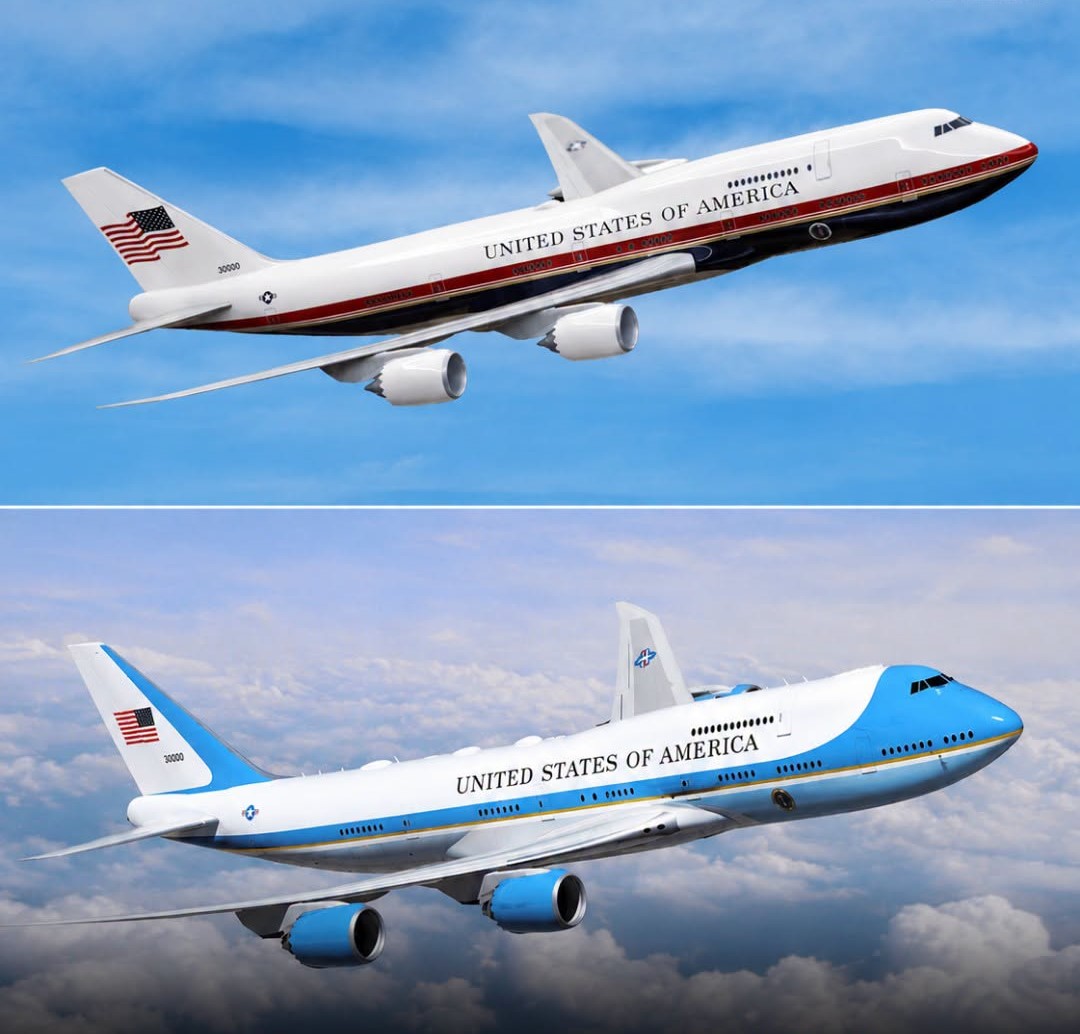
The newest presidential Boeing 747 has officially carried President Donald Trump. But when the United States launched strikes on Iran and the president prepared to leave Turkey, Trump did something that immediately caught the attention of aviation and security observers.
He boarded the old, 35-year-old modified Boeing 747 instead.
Across the tarmac sat the newly converted Boeing 747-8 that had been introduced with enormous fanfare only days earlier.
That decision has intensified a major question: Is the new presidential aircraft truly equipped to deal with the extreme threats Air Force One could face?
The former Qatari head-of-state Boeing 747-8 entered presidential service after roughly a year of upgrades and conversion work — an extraordinarily compressed timeline for an aircraft expected to function as a heavily fortified “flying White House.”
Trump first flew aboard the aircraft in early July, using it for a trip to Bismarck, North Dakota. But flying over the United States is one thing. Operating near an active Middle Eastern conflict, with missiles still flying and Iran sharing a border with Turkey, presents an entirely different security environment.
Shortly after taking off aboard the OLDER presidential jet, Trump himself acknowledged the potential danger.
“Air Force One could be a dangerous plane because of the sleaze bags we have to deal with,” Trump said. “These are sick people, so I could see something like that.”
Sources told CNN there was no specific new threat to Trump’s life. However, the president had previously raised the possibility of an Iranian assassination attempt during the NATO summit.
 THE BIG QUESTION: WHAT DEFENSIVE SYSTEMS DOES THE NEW 747 ACTUALLY HAVE?
Most details surrounding Air Force One’s protection systems are classified — and for obvious reasons, the White House and Air Force do not publicly provide a complete list of defensive capabilities.
But aviation and security experts are questioning whether a roughly one-year conversion could possibly replicate systems developed and integrated into the existing presidential fleet over years.
The older VC-25A aircraft — heavily modified Boeing 747-200s — are widely believed to carry sophisticated missile countermeasures.
These reportedly include systems capable of detecting and defeating infrared-guided missile threats.
Aviation observers studying photographs of the new Boeing 747-8 have noted that the aircraft appears to lack visible external tail-cone modifications commonly associated with certain directional infrared missile defense systems.
That DOES NOT prove the aircraft lacks missile protection. Classified systems may not always be identifiable from photographs.
But it has raised questions.
The older presidential aircraft are also widely believed to carry chaff — bundles of metallic material that can be released to create false radar targets and confuse radar-guided missiles.
Whether the new aircraft carries comparable electronic warfare and self-protection systems remains unclear.
SECURE COMMUNICATIONS MAY BE AN EVEN BIGGER CHALLENGE
Air Force One isn’t simply a luxury aircraft for presidential travel.
The president must be able to command the United States from the aircraft during a military crisis, nuclear emergency or major national security event.
That requires an enormous network of secure and encrypted communications equipment.
Former Air Force Secretary Frank Kendall explained that installing the necessary antennas alone can require structural modifications to the aircraft.
“You have to basically do structural changes to put the antennas in,” Kendall said. “Some of that, I’m sure they did. I’m not sure how much.”
Richard Aboulafia of AeroDynamic Advisory argued that the aircraft’s unseen internal systems are where the biggest differences may exist.
A fully equipped presidential aircraft requires an integrated electronic warfare system, electronic countermeasures, missile protection and an extensive communications suite capable of connecting the president with military and allied commanders anywhere in the world.
Installing and integrating those systems is an extremely complex and time-consuming process.
WHAT ABOUT A NUCLEAR ATTACK OR EMP?
Another unanswered question concerns protection against nuclear-related threats.
The older presidential Boeing 747s were designed during the Cold War and are believed to incorporate systems intended to protect critical equipment against electromagnetic pulse — or EMP — effects associated with nuclear events.
It remains publicly unclear whether the newly converted Boeing 747-8 has comparable hardening.
For an ordinary VIP aircraft, this might sound excessive.
For Air Force One, it is part of a much bigger mission: ensuring the commander in chief can continue operating during the worst imaginable national emergency.
AIR FORCE ONE IS ALSO A FLYING MEDICAL FACILITY
The traditional Air Force One configuration includes far more than offices and communications equipment.
According to the White House, the aircraft typically carries a medical suite capable of functioning as an operating room, with a doctor permanently aboard.
Life-support capabilities, emergency medical facilities, secure command systems and defensive equipment all have to be integrated into a single aircraft.
Kendall estimates the former Qatari jet may have required THREE TO FOUR YEARS of modifications to reach the same standards as the existing presidential Boeing 747 fleet.
Instead, the conversion was completed in roughly a year.
“It was a schedule driven modification,” Kendall said.
Trump wanted the aircraft flying by July 4 and made his first trip aboard it on July 3.
According to Kendall, meeting that schedule likely meant the conversion team had to prioritize certain capabilities.
“To do that, they would have had to leave out a lot of things that are on a regular Air Force One,” he said.
The White House strongly disputes suggestions that security was compromised.
A senior administration official said minimal changes were made to the aircraft’s existing head-of-state interior to accelerate delivery, while insisting the Air Force accepted “no risk regarding security, safety, or secure communications.”
Officials say the work focused on ESSENTIAL systems rather than cosmetic modifications.
ONE CAPABILITY IT DEFINITELY DOESN’T HAVE: AERIAL REFUELING
The new Boeing 747-8 lacks the aerial refueling capability found on the older presidential aircraft.
On the VC-25A, equipment associated with the capability can be identified by a noticeable feature around the nose of the aircraft.
Although rarely used, aerial refueling theoretically allows the presidential aircraft to remain airborne for an extraordinarily long period during a major crisis.
Interestingly, the future VC-25B aircraft currently being developed by Boeing to replace the older presidential fleet will also reportedly lack aerial refueling capability.
So this particular omission is not unique to the former Qatari aircraft.
SO WHY DID TRUMP USE THE OLD AIR FORCE ONE FROM TURKEY?
That remains the most fascinating question.
The new Boeing 747-8 has flown the president.
It has been introduced as a presidential aircraft.
And Trump has publicly praised its rapid transformation.
Yet during a highly sensitive Middle East trip — as the United States carried out strikes against Iran — the president departed Turkey aboard the OLD presidential Boeing 747.
Was it simply an operational decision?
A logistical issue?
Or does the older VC-25A still provide capabilities considered essential when Air Force One operates in a high-threat environment?
The exact answer may remain classified.
But one thing is clear: converting a luxury head-of-state Boeing 747 into a true “flying White House” involves far more than new paint, secure rooms and presidential seating.
Air Force One must potentially survive missile threats, maintain communications during nuclear emergencies, support the commander in chief during war and provide emergency medical care thousands of feet above the ground.
The new 747 is flying.
The question aviation and security experts are now asking is much more serious:
IS IT FULLY READY FOR THE DAY WHEN AIR FORCE ONE’S MOST CLASSIFIED CAPABILITIES ARE ACTUALLY NEEDED?