
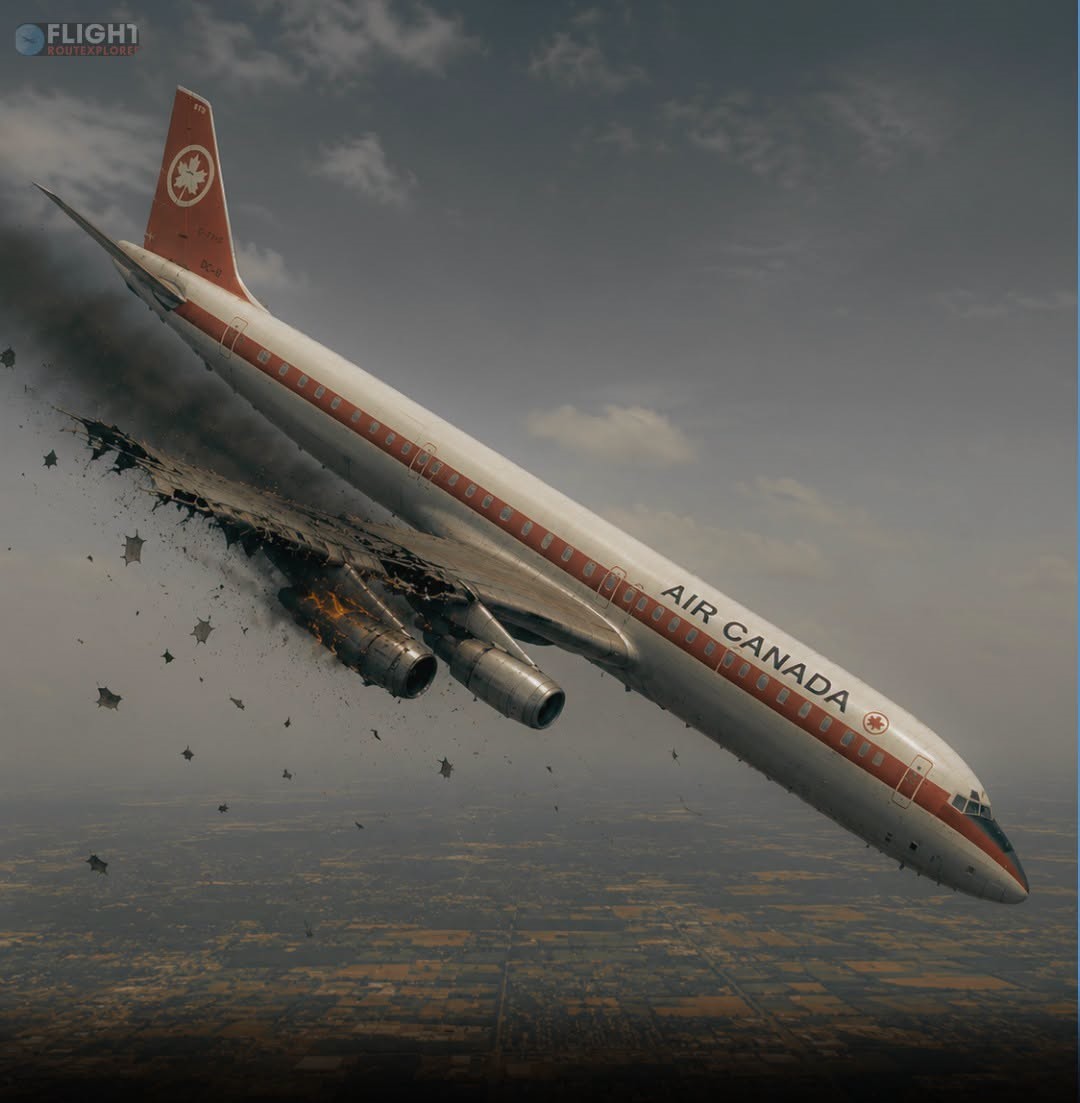
On July 5, 1970, what began as a routine domestic flight from Montreal to Toronto turned into one of the darkest days in Canadian aviation history.
Air Canada Flight 621, a nearly new Douglas DC-8-63 that had accumulated only around 453 flight hours, was scheduled to continue onward to Los Angeles after its stop in Toronto.
Instead, a single mistake made only seconds before touchdown triggered a sequence of events that left no chance of survival for the 109 people on board.
The tragedy remains one of the most studied examples of how a seemingly minor cockpit error, combined with procedural deviations and aircraft design limitations, can escalate into a catastrophic accident.
The aircraft departed Montreal without any reported technical issues. Weather conditions around Toronto were suitable for landing, and the flight progressed normally throughout the cruise and descent.
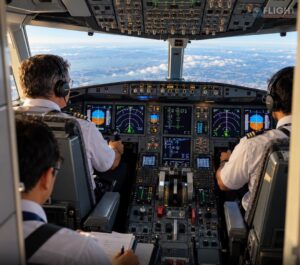
The captain, First Officer, and flight engineer were experienced, but the captain and First Officer had developed an unofficial practice regarding the aircraft’s ground spoilers. Instead of following Air Canada’s approved checklist, which required the spoilers to be armed before landing, they had adopted their own methods because both pilots were concerned about the possibility of accidental spoiler deployment. This unofficial agreement would prove fatal.
As the DC-8 descended toward Toronto International Airport, the captain was flying the aircraft. During the final seconds before touchdown, the captain instructed the First Officer to “give them to me on the flare.” The intention was to arm the ground spoilers during the landing flare. However, instead of moving the lever into the armed position, the First Officer accidentally deployed the spoilers while the aircraft was still approximately 60 feet above the runway.
The effect was immediate. The spoilers destroyed much of the wing’s lift while the aircraft was still airborne. The DC-8 suddenly sank toward the runway much faster than expected. Realizing something had gone terribly wrong, the captain pulled back on the control column and applied full engine power in an attempt to arrest the descent. Although the nose rose, there was simply not enough altitude left to recover completely. The aircraft slammed onto the runway with tremendous force.
The violent impact caused extensive structural damage. The number four engine on the right wing struck the runway and tore away from the aircraft. The tail also hit the runway, while the damaged wing structure suffered severe internal failures. Unknown to the crew, the impact had ruptured the right-wing fuel tanks and compromised the wing’s structural integrity. Despite the heavy landing, the aircraft became airborne again as the captain initiated a go-around, believing another landing attempt was possible.
As Flight 621 climbed away from the airport, aviation fuel poured from the damaged right wing. The crew requested another landing, but the original runway had already been closed because debris from the aircraft—including the detached engine—was scattered across it. Air traffic control instructed the crew to prepare for landing on another runway. Neither the pilots nor controllers knew that the aircraft had already suffered fatal structural damage.
Approximately two and a half minutes after the hard landing, the damaged right wing could no longer withstand the aerodynamic loads. A powerful explosion erupted near the outer section of the wing above the missing number four engine. Seconds later, another explosion occurred near the number three engine, causing that engine and its pylon to separate from the aircraft. Just a few seconds after that, a third explosion destroyed most of the remaining outer right wing. With nearly the entire right wing gone, the DC-8 immediately rolled uncontrollably and entered a steep nose-down dive. The aircraft crashed into farmland near Brampton, Ontario, at an estimated speed of about 220 knots. The impact was unsurvivable, killing all 100 passengers and 9 crew members.
The aftermath was devastating. The aircraft dug a deep crater into the ground, and wreckage was scattered across a wide area. Recovery teams faced extremely difficult conditions because of the force of the impact and the explosions that followed. The recovery and identification of victims took considerable time, with investigators needing to excavate the crash site carefully. Many victims were from Southern California, as Toronto was only an intermediate stop before the flight’s final destination of Los Angeles. The disaster became the deadliest accident in Air Canada’s history after the airline adopted its new name in 1965 and remains one of Canada’s worst aviation tragedies.
Investigators conducted an extensive examination of the wreckage and cockpit voice recorder. Their findings showed that there had been no mechanical failure before the spoiler deployment. Instead, the investigation concluded that pilot error initiated the accident. The First Officer unintentionally deployed the spoilers instead of merely arming them, while both pilots had already abandoned Air Canada’s approved landing procedures in favor of their own unofficial technique. Investigators also determined that the design of the spoiler control allowed deployment while airborne, making such an error possible.
The Board of Inquiry issued several important safety recommendations. It called for redesigning the spoiler system so it could not be accidentally deployed in flight, strengthening the structural integrity of the DC-8’s wing and fuel tanks to better withstand severe impacts, and improving Air Canada’s training manuals to eliminate ambiguity surrounding spoiler operation. The accident also reinforced the importance of strict adherence to standard operating procedures and highlighted the dangers of cockpit crews developing informal methods outside approved checklists.
More than five decades later, Air Canada Flight 621 continues to be studied by pilots, investigators, and aviation safety experts worldwide. The tragedy demonstrated that catastrophic accidents do not always begin with major mechanical failures. Sometimes, a single incorrect control movement lasting only a fraction of a second can begin an irreversible chain of events. The lessons learned from Flight 621 led to improvements in aircraft design, pilot training, and operating procedures that continue to influence aviation safety today.