
Cause of wrongly-positioned aircraft control in Shellharbour fatal crash remains unknown.
The Australian Transport Safety Bureau (ATSB) has released its final report into the tragic light aircraft crash at Shellharbour Airport, New South Wales, that claimed the lives of pilot Andrew Connors, his wife Julianne Connors, and their friend Colin McLaughlin shortly after takeoff during the October 2025 long weekend.
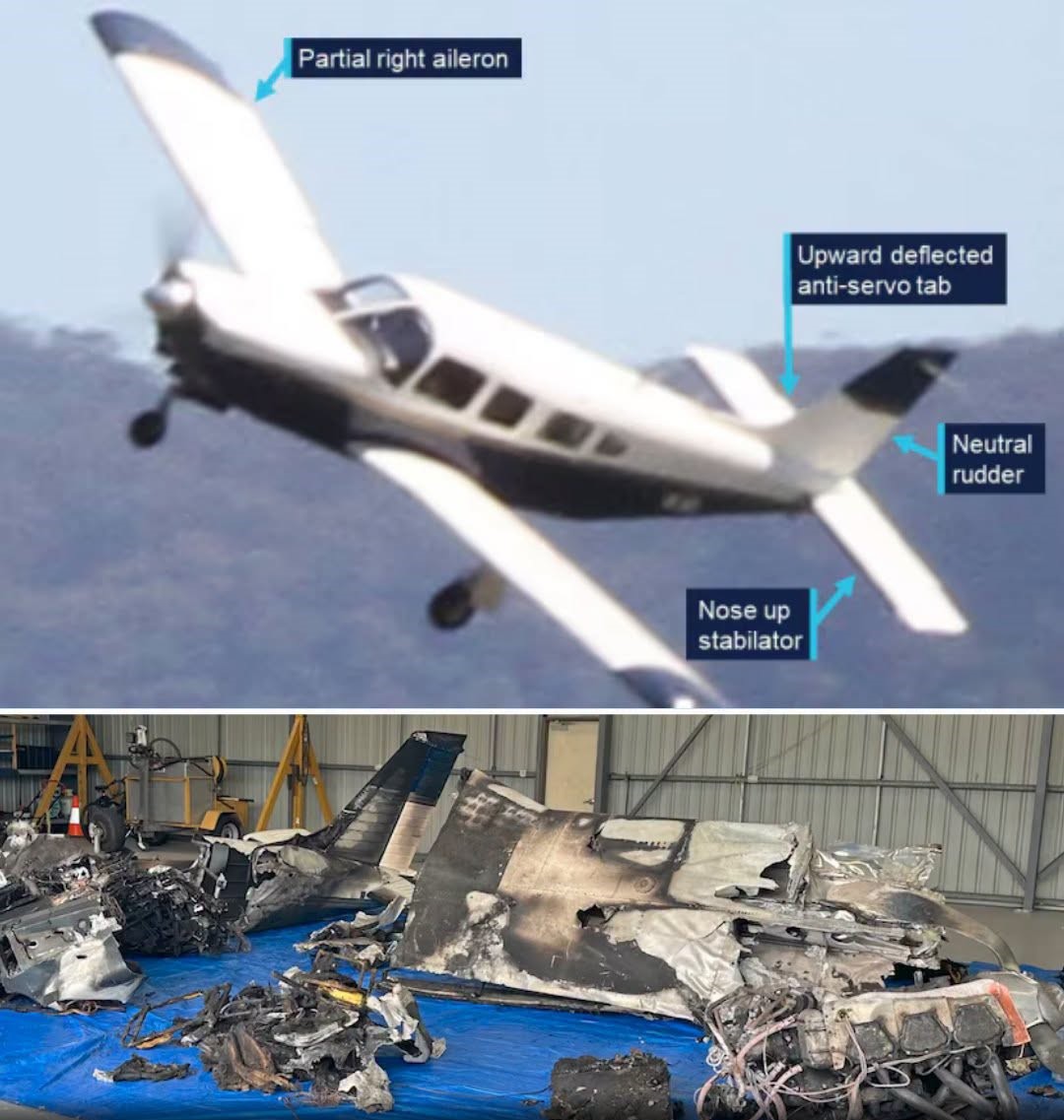
According to investigators, the Piper Cherokee Lance became airborne after a ground roll of approximately 400 metres before pitching up sharply, yawing to the left, entering an aerodynamic stall, and crashing onto the runway intersection. The aircraft burst into flames on impact, leaving no survivors.
The ATSB determined that the aircraft’s horizontal stabilator—the movable tail surface responsible for controlling pitch and maintaining longitudinal stability—failed to move into the correct takeoff position. Instead, it remained in a full nose-up setting, creating excessive pitch that the aircraft could not sustain. Within seconds of liftoff, the aircraft lost critical airspeed, stalled, and descended with little opportunity for recovery.
Despite an extensive year-long investigation involving examination of the wreckage, security camera footage, witness photographs, maintenance records, and post-mortem findings, investigators could not determine why the stabilator was incorrectly positioned.
ATSB Chief Commissioner Angus Mitchell said investigators examined numerous possible causes, including bird or animal strikes, unsecured objects inside the cabin, environmental factors, flight control interference, and pilot medical incapacitation. None of these possibilities were supported by the available evidence.
The report also confirmed there was no indication of a mechanical failure that directly caused the stabilator’s incorrect position, nor any evidence that pilot Andrew Connors—who had accumulated more than 1,000 flight hours, including around 27 hours on the accident aircraft—made an identifiable error that explained the abnormal control setting.
The ATSB noted that pilots are generally not trained to respond to an unexpected nose-up pitch immediately after takeoff, making recovery from such an event extremely difficult due to the low altitude and limited reaction time.
While the investigation has identified what caused the aircraft to lose control, the reason the stabilator was in the wrong position remains unanswered. The tragedy serves as a sobering reminder of how rapidly an aircraft can become unrecoverable during the critical moments after takeoff and highlights the importance of continued research and pilot awareness regarding rare but catastrophic flight control anomalies.
Our thoughts remain with the families and friends of Andrew Connors, Julianne Connors, and Colin McLaughlin.