
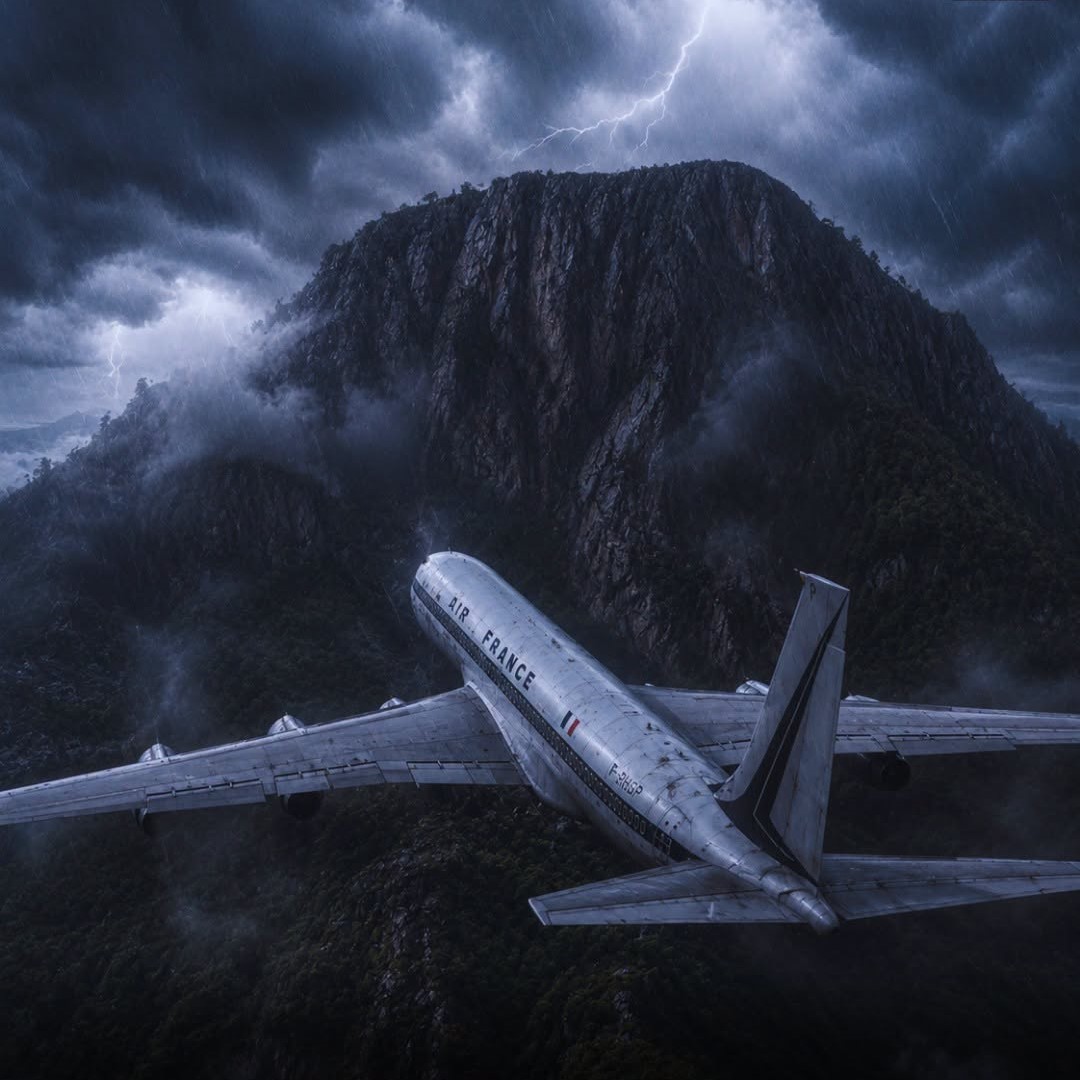
On June 22, 1962, Air France Flight 117, a Boeing 707-328 named Château de Chantilly, was nearing the end of a long intercontinental journey when disaster struck over the Caribbean island of Guadeloupe.
What makes the tragedy particularly haunting is that the aircraft was only about four months old and had successfully completed most of its multi-stop route from Paris to South America. Instead of landing safely, the jet slammed into a hillside hidden by storm clouds, killing all 113 people on board.
The flight had departed Paris-Orly Airport and was operating a scheduled service to Santiago, Chile, with planned stops in Lisbon, the Azores, Guadeloupe, Caracas, Lima, and other destinations.
The journey proceeded normally across the Atlantic. By the time the Boeing 707 approached Pointe-à-Pitre in Guadeloupe during the evening hours, passengers and crew were preparing for what should have been a routine landing before continuing southward.
As the aircraft neared Guadeloupe, conditions began to deteriorate. The airport was surrounded by mountainous terrain, making instrument navigation especially important during poor weather. A violent thunderstorm had developed over the area, bringing heavy rain, low clouds, and reduced visibility. To make matters worse, the airport’s VOR navigation beacon—an important aid used by pilots for accurate positioning—was out of service at the time. The crew therefore had to rely more heavily on other navigation equipment while conducting the approach.
The crew reported passing over the airport’s non-directional beacon at approximately 5,000 feet and began the procedure for final approach. Unknown to them, the severe atmospheric disturbances generated by the thunderstorm were affecting the aircraft’s Automatic Direction Finder (ADF), causing inaccurate indications. As a result, the Boeing gradually drifted away from the correct descent path. Instead of remaining on the published approach track, the aircraft moved roughly 15 kilometers west of where it should have been.
Still believing they were correctly aligned for the approach, the pilots continued descending through the storm. At approximately 1,400 feet above sea level, the Boeing 707 flew directly into the forested slopes of Dos d’Âne, a hill located northwest of Pointe-à-Pitre. The impact was catastrophic. The aircraft exploded on contact and was destroyed. None of the 103 passengers and 10 crew members survived. Among the victims were several notable figures, including French Guianan politician and war hero Justin Catayée and poet Paul Niger.
Rescue efforts were immediately hampered by darkness, rugged terrain, and severe weather. Search teams eventually reached the wreckage but quickly realized there were no survivors. The disaster became one of the deadliest aviation accidents involving Air France at the time and occurred less than three weeks after another major Air France Boeing 707 tragedy, Flight 007, which had crashed during takeoff near Paris on June 3, 1962. The two disasters in the same month shocked both the airline and the aviation industry.
Investigators examined the navigation systems, weather conditions, airport facilities, and flight procedures. They ultimately concluded that the crash was a classic case of controlled flight into terrain (CFIT), meaning the aircraft was fully controllable and functioning but was unintentionally flown into the ground. The investigation could not pinpoint a single definitive cause, but several contributing factors emerged. The airport’s VOR beacon was unavailable, meteorological information provided to the crew was considered insufficient, and thunderstorm-related atmospheric disturbances likely produced misleading ADF indications. Together, these factors caused the aircraft to stray significantly from the safe approach corridor.
Another revelation emerged years later from Boeing Chief Test Pilot Tex Johnston. In his autobiography, Johnston described concerns regarding the training and qualification of the captain involved in the accident. He wrote that he had previously expressed doubts about the pilot’s readiness to command the Boeing 707 and had communicated those concerns to Air France management. Johnston claimed the captain later qualified through another instructor and subsequently crashed during an approach in poor weather. While these comments were not part of the official accident findings, they have remained one of the most discussed aspects of the tragedy among aviation historians.
The crash also highlighted a broader issue facing the early jet age. Air France pilots criticized the limited infrastructure available at some overseas airports that were now receiving advanced jet aircraft. Navigation aids, weather reporting systems, and approach facilities in several locations had not yet evolved to match the demands of high-speed jet operations. The Flight 117 disaster became an example of how technological advances in aircraft could outpace the capabilities of the airports serving them.
More than six decades later, the memory of Air France Flight 117 remains alive in Guadeloupe. Memorial monuments have been erected at the crash site, and a road leading toward the area is known as Route du Boeing. Some wreckage remnants remained visible for years in the dense forest, serving as a silent reminder of the tragedy that unfolded on a stormy Caribbean night in 1962. What began as a routine descent after a successful Atlantic crossing ended in one of the most devastating examples of how weather, navigation failures, and terrain can combine to create a fatal chain of events.