
Pilots dislike using it. Drivers post videos on social media showing how low jetliners roar over the New Jersey Turnpike when flights use Newark Liberty Airport’s oldest and shortest runway.
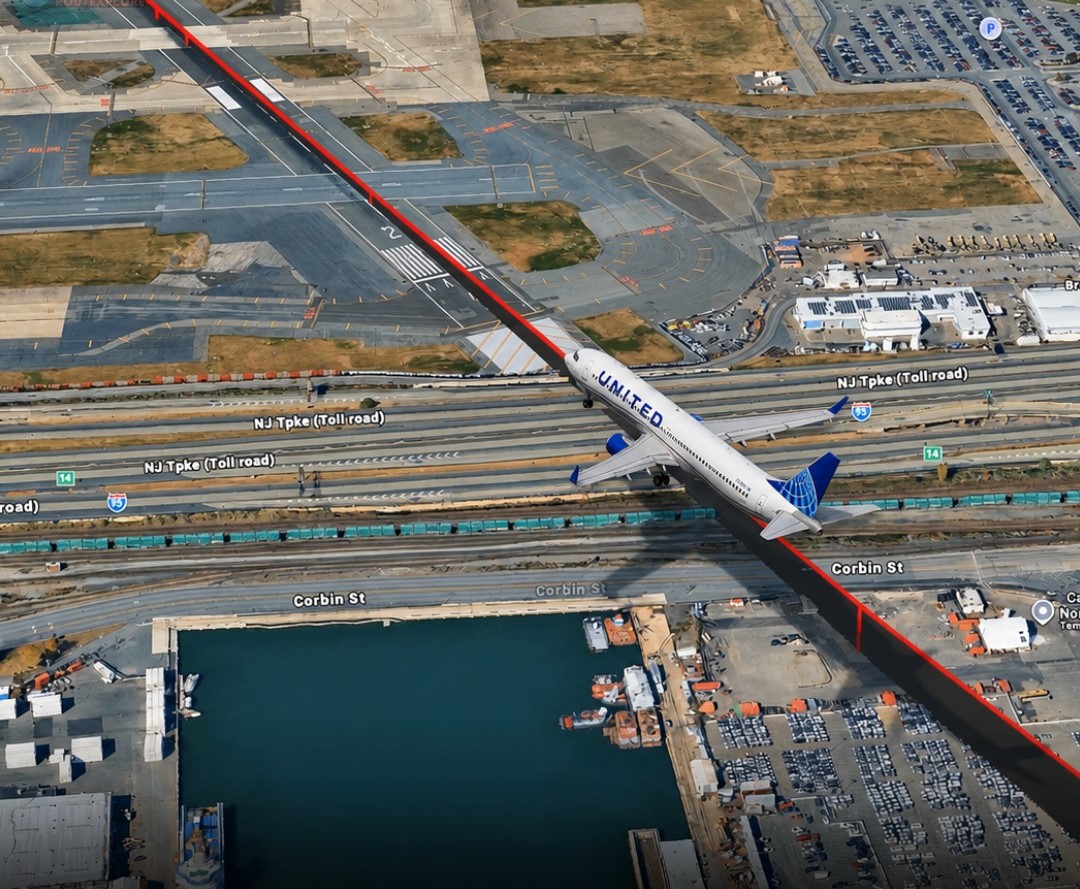
United Airlines flight 169 from Venice was landing on Runway 29 on Sunday around 2 p.m. when it clipped a light pole on the New Jersey Turnpike, and the landing gear, dislodged from the aircraft, hit a truck.
None of the 221 passengers and 10 crew members on board the flight were injured, but the driver of a southbound tractor-trailer sustained minor injuries when a tire from the aircraft came through the windshield.
Attorney Kevin Mahoney of Kreindler & Kreindler, a major aviation law firm, said everyone on the plane was very fortunate.
“It could have been a lot worse than it was,” he said.
The FAA is in charge of which runways are used and when. Use of runway 29 will continue, the agency said.
“The FAA evaluates flight patterns and airspace management and determined that due to the precise location of the Newark Airport Runway 29 landing threshold and its proximity to the New Jersey Turnpike, a direct approach over the Turnpike is required for safe landings,” an FAA spokesperson said.
The airport’s two main runways, 4L and 4R, were designed and built to move air traffic away from Elizabeth and Newark.
Runway 29 was one of several runways constructed during World War II, when the U.S. Army took over the airport for military use.
Other runways that were constructed during the war were eventually closed to keep air traffic away from the Elizabeth and Newark neighborhoods after three planes crashed in an almost two-month period between 1951 and 1952.
On Dec. 16, 1951, a plane crashed into a warehouse in Elizabeth, killing all 56 people aboard. On Jan. 22, 1952, a flight from Syracuse crashed into a row of homes on Williamson Street at 3:45 p.m., killing all 23 aboard.
On Feb. 11, 1952, a National Airlines DC-6 to Miami crashed into a four-story apartment building on Salem Avenue after take-off, killing 29 people, including four on the ground.
Flights using Runway 6 had to fly directly over “the business center of Elizabeth” 400 feet away from the county courthouse.
The Port Authority of New York and New Jersey, which leased the airport from the city starting in 1948, voluntarily shut it down ahead of demands from Elizabeth residents that a congressional subcommittee close the airport.
The airport remained closed until November 1952 while a congressional subcommittee examined airport safety. Recommendations led to the construction of runways 4L and 4R and the eventual closing of all the older runways except runway 29.
That runway was later lengthened by the Port Authority, but it is still shorter than the two main runways.
The use of runways depends on wind conditions and is decided by airport air traffic controllers, experts said.
“Runway 29 goes mostly east to west. The use of 29 may have been due to wind or capacity limitations on that day,” said Professor Sheldon H. Jacobson, an aviation safety expert at the University of Illinois
The National Weather Service reported wind speeds of 29 mph and gusts of 41 mph for Newark on Sunday, May 3.
Flights using Runway 29 typically approach from the north, flying over the New Jersey Turnpike Newark Bay extension, which runs east–west, and then turning right to fly over the Turnpike’s main north-south highway to land.
An airline pilot who regularly flies into Newark Liberty and who asked not to be identified because of the nature of his job said he has flown approaches to Runway 29 on numerous occasions.
“On Sunday, it was very gusty, which makes this approach and landing particularly challenging for the pilot flying,” he said. “We do come in quite low over the Turnpike, but not lower than would be expected, based on the distance from the runway touchdown zone.
“Personally, I have never thought I would be at risk of striking a vehicle or light pole any of the times I have flown this approach.”
But he noted that Newark shifts to that runway when the winds are strong from that direction.
Runway 29 at Newark Liberty requires a very tight approach. It can be used for arrivals and departures, but the east-west runway is not commonly used.
According to the FAA, some jets cannot land or take off from the shorter runway.
Some pilots don’t like using it because when an aircraft comes from the east, they must turn into the final approach over the Newark Bay Bridge.
Arrivals from the west can interrupt the final approaches by aircraft to Teterboro and Morristown airports.
“When the wind is gusting from the west, they will often land on 29,” said Mahoney. “It is a far more dramatic approach. You are quite low over the water and then turn west over the runway.”
It’s more hazardous approach because pilots must accomplish more in less time and with less room, he said.
“It doesn’t take a rocket scientist to determine that the United flight was too low,” Mahoney said.
The National Transportation Safety Board, which sent an investigator to Newark on Monday, will need to determine whether the crew made an error or was distracted, he said.
Among the issues it will examine is whether the pilots made miscalculations based on the wind, on the plane’s weight, or on where they needed to be, he said.
But such occurrences are rare, Jacobson said.
The NTSB deemed it an accident due to the extent of damage to the aircraft. An investigation underscored the seriousness of the incident, Mahoney said.
On Monday, investigators interviewed crew members who had been removed from service by United on Sunday.
The probe will examine multiple factors, including flight operations, meteorological conditions, human and aircraft performance, crew resource management and air traffic control.
Mahoney said the board will likely look at whether there is a need to reduce obstacles, such as the light pole that was hit, or to implement new landing requirements.
The light posts are shorter on the New Jersey Turnpike near the airport under an FAA requirement, said Tom Feeney, a Turnpike Authority spokesperson.
Highways in close proximity to airports aren’t unusual. Flights landing on LaGuardia Airport Runway 4 fly over the Grand Central Expressway, which also has shortened light posts and runway directional lighting along the sides of the highway.
“Airports often cover a large footprint of land. Invariably, there are highways around the airport and in the line of takeoff and landing,” Jacobson said.