



On Mar 11th 2024, what began as a routine trans-Tasman crossing turned into a midair emergency that investigators would later trace not to turbulence or catastrophic system failure—but to a pilot’s seat.
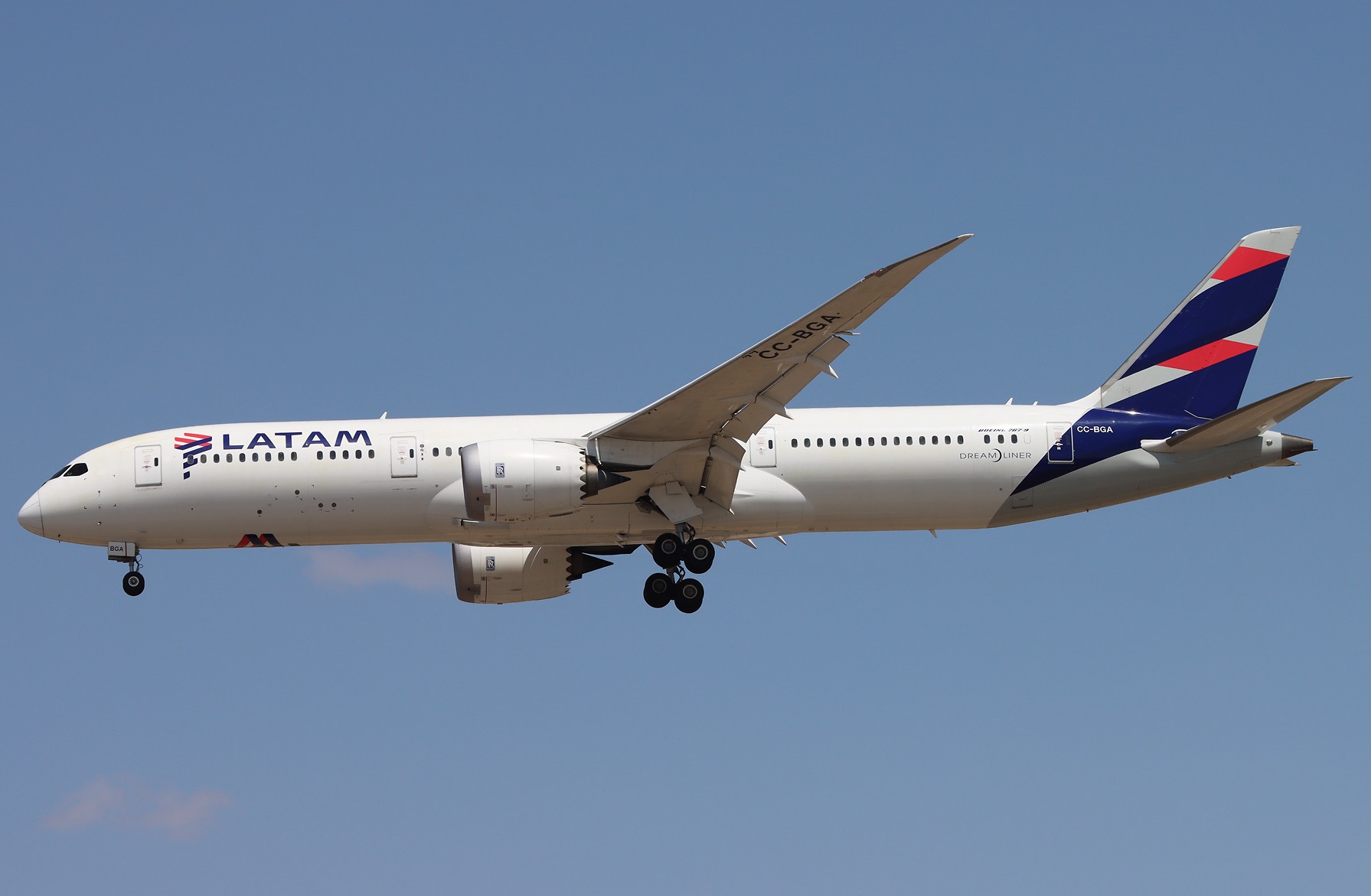
A LATAM Airlines Chile Boeing 787-9, registration CC-BGG, was operating flight LA-800 from Sydney Kingsford Smith International Airport to Auckland Airport with 263 passengers and 9 crew on board. Cruising smoothly at FL410—41,000 feet—over the Tasman Sea, the aircraft suddenly pitched into an abrupt, uncommanded descent.
Passengers later described a terrifying moment of weightlessness about 50 minutes before landing. Unsecured items shot upward, striking the cabin ceiling. Some passengers followed. Blood reportedly stained overhead panels. The violent movement injured 12 people, one seriously. Around 50 passengers were assessed on arrival in Auckland, with 12 transported to hospital.
Despite the chaos in the cabin, the flight crew regained control and continued to Auckland without further incident.
In the immediate aftermath, the airline described the event as a “technical incident” that caused strong aircraft movement. Early speculation centered on possible flight system anomalies. The captain reportedly told passengers the crew had briefly lost instrumentation before it returned.
Both New Zealand’s Transport Accident Investigation Commission and Australia’s Australian Transport Safety Bureau noted the occurrence, but because the upset happened in international airspace, the investigation was led by Chile’s Direccion General de Aeronautica Civil (DGAC).
Initial attention also drifted toward a 2016 airworthiness directive issued by the Federal Aviation Administration concerning potential simultaneous resets of the Boeing 787’s flight control modules if left continuously powered for extended periods. Around the same time as the incident, Boeing had also circulated messages to operators about a known issue involving rocker switch caps on cockpit seat controls that could detach and cause unintended seat movement.
Those details would later prove crucial.
In a preliminary report released on Apr 19th 2024, Chile’s DGAC confirmed that the aircraft had experienced a sudden, unintentional descent of approximately 400 feet. Weather and turbulence were ruled out. Critically, investigators noted that the captain’s seat had begun an involuntary forward movement at the time of the upset.
The final report, published in February 2026, revealed the extraordinary chain of events.
Shortly before the descent, the aircraft was stable at cruise altitude with the First Officer acting as Pilot Flying, autopilot engaged. The Cabin Manager had entered the cockpit for routine coordination. Another cabin crew member then entered to collect meal trays. During this interaction, the protective guard covering the captain’s seat rocker switch was inadvertently pressed.
Unbeknownst to the crew, the rocker switch cap had detached from its base and was sitting in an abnormal position. Any pressure on the switch guard could activate the seat motor. When the guard was pushed, the captain’s seat began moving forward uncontrollably.
At that moment, the captain was seated turned slightly to the right, his left leg crossed over his right while speaking with the Cabin Manager. As the seat surged forward, his legs became trapped against the control column. The forward motion forced his body into the controls, increasing pressure on the column force sensor.
That pressure exceeded the autopilot’s permissible limits.
The autopilot disconnected.
With cruise power set and no immediate corrective input, the aircraft pitched into a sudden descent. The crew momentarily lost control as the aircraft dropped roughly 400 feet. Inside the cabin, the abrupt negative g-forces sent passengers and objects upward.
In the cockpit, the First Officer reacted quickly. He communicated clearly with the captain, disengaged electrical power to the captain’s seat to stop the movement, and worked to regain pitch control. Once the captain freed his legs and control forces normalized, the crew stabilized the aircraft and re-engaged the autopilot, climbing back to their assigned altitude.
Investigators concluded the probable cause was the sudden and involuntary descent resulting from pressure applied by the captain’s body against the control column force sensor, itself triggered by uncontrolled forward movement of his seat.
Contributing factors included the detached rocker switch cap, design and manufacturing issues with the switch assembly, and the crew’s lack of prior experience with how an uncontrolled seat movement could directly affect flight controls. Notably, earlier that day in Sydney, the captain had sensed an unusual seat movement during preflight checks but did not log it, having verified that visible switches appeared to function normally.
Maintenance records showed no outstanding discrepancies. Mandatory service bulletins regarding switch improvements had been complied with, though a non-mandatory earlier bulletin recommending adhesive reinforcement had not been applied to the seat involved. Even after subsequent inspections mandated by a 2024 FAA directive, operators reported continued damage to rocker switch components across fleets.
In the end, the incident underscored a sobering reality of modern aviation: in a cockpit filled with advanced automation, fly-by-wire controls, and layers of redundancy, a small mechanical component—no larger than a fingertip—can trigger a cascade that sends a 250-ton jetliner briefly out of the sky.
On Mar 11th 2024, over calm international waters with no turbulence in sight, it wasn’t weather or engine failure that startled hundreds aboard a state-of-the-art Dreamliner.
It was a seat.