




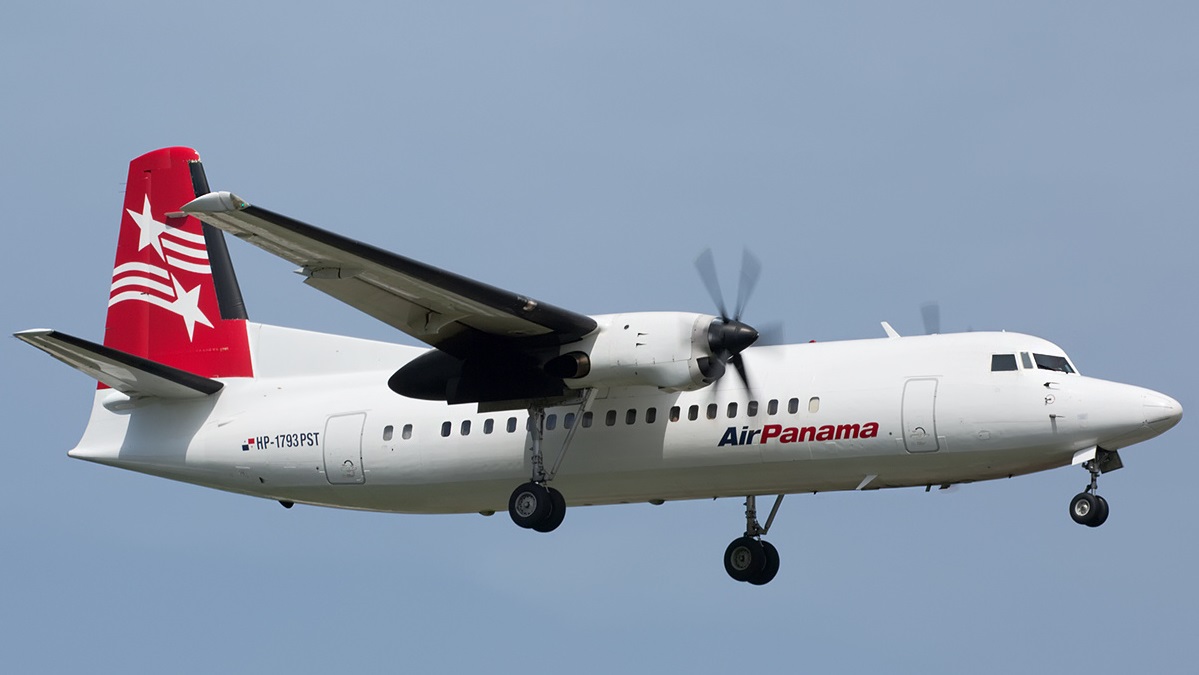
On May 16th 2025, an Air Panama Fokker 50, registration HP-1899PST, was destroyed after veering off the runway during landing at Bocas del Toro, Panama.
Flight 7P-982 had departed Panama City with 32 passengers and three crew members on board. The aircraft touched down on runway 27 at Bocas del Toro at 22:01 local time (03:01Z May 17th) in rainy nighttime conditions. After landing, the aircraft veered to the right and departed the runway surface, coming to a stop approximately 720 meters beyond the threshold and about 13 meters off the right edge of the runway at coordinates N9.3408 W82.2508. The aircraft ultimately struck vegetation roughly 1,000 meters down the runway.
Panama’s civil aviation authority, the AAC, confirmed the accident and stated that all 35 passengers and three crew were evacuated. While initial information indicated no injuries, the preliminary report later clarified that one crew member sustained serious injuries, while the remaining crew and passengers suffered minor or no injuries.
The aircraft sustained catastrophic structural damage. The tail section detached, one engine separated completely, the right wing detached, and the left wing and left engine were partially torn away. The damage was assessed as beyond economic repair.
According to the AAC’s preliminary report released in June 2025, the first officer was pilot flying and the captain was pilot monitoring. Upon initial contact, tower reported moderate rain, calm winds, and a wet runway. The captain indicated they would proceed to 10 nautical miles for approach and divert if necessary. As the aircraft reached 10nm and commenced final approach, tower advised that thunderstorms and electrical activity were present over the aerodrome. At 4nm, tower had the aircraft in sight. The crew reported the runway in sight and were cleared to land on runway 27 with calm winds and caution for a wet surface.
Evidence of braking action was found beginning approximately 502 meters beyond the runway threshold. The aircraft then deviated to the right of the centerline and, after touchdown, lost directional control, resulting in a runway excursion on the same side.
In its final report, issued in Spanish, the AAC concluded that the probable cause was the aircraft’s deviation to the right of the runway centerline during approach, followed by loss of control after touchdown and a runway excursion. Contributing factors included failure to comply with dispatch requirements for accurate meteorological information, lack of adequate ground dispatch supervision, the crew’s decision to continue the flight despite deteriorating weather, the captain’s decision not to take control for landing, poor nighttime visual conditions exacerbated by rain, and a destabilized approach profile.
The accident underscores the compounding risks of unstable approaches, degraded visual cues on wet runways at night, and convective weather activity in the vicinity of the airport.