




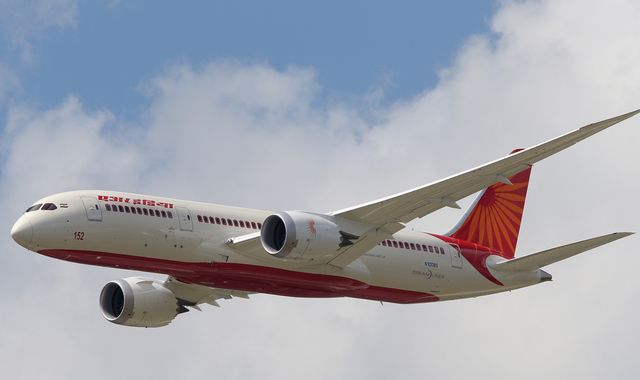
On Jun 12th 2025, tragedy struck just seconds after departure when an Air India Boeing 787-8, registration VT-ANB, operating flight AI-171 from Ahmedabad, India to London Gatwick, UK, crashed into a residential hostel complex at BJ Medical College in the Meghaninagar suburb, killing 241 of the 242 people on board and at least 19 people on the ground, with dozens more injured.
The aircraft, powered by General Electric GENx engines, departed runway 23 at 13:38 local time (08:08Z) with 230 passengers and 12 crew. Moments after liftoff, the crew transmitted a desperate call: “MAYDAY MAYDAY MAYDAY – No thrust, not taking lift.” According to India’s DGCA, the Mayday was issued at 13:39L (08:09Z). There was no further response.
The Dreamliner crashed approximately 0.9 nautical miles beyond the runway end, first impacting at position N23.056 E72.612, with wreckage scattered across 200 meters. Ground witnesses described a low, struggling climb before the aircraft descended into hostel buildings housing medical students. One student reportedly survived by jumping from the structure. BJ Medical College later confirmed three of its students were among the dead. Roughly 50–60 students were injured.
Initial police reports suggested no survivors aboard the aircraft. However, in the late evening, authorities confirmed one passenger seated in 11A survived, suffering multiple injuries but escaping through an opening in the wreckage. He later recounted that cabin lights flickered green and white shortly after liftoff and the aircraft felt “stuck in the air” before slamming into the building.
Air India confirmed that 241 people on board perished. The passengers included 169 Indian, 53 British, 1 Canadian, and 7 Portuguese nationals. The captain, aged 60, had accumulated approximately 8,200 flight hours and was nearing retirement; the first officer had around 1,100 hours.
Data later revealed the aircraft had used the full 3,505-meter runway following a backtrack. Government officials stated the takeoff roll was longer than normal. ADS-B data showed the aircraft reaching about 625 feet MSL (approximately 75 feet AGL) and 174 knots groundspeed before data ceased.
Early speculation considered bird strike, loading issues, and pilot error. By Jun 13th, the DGCA ruled out bird strike due to absence of remains and described loading as routine. Simultaneous dual engine failure was deemed highly unlikely, and pilot error considered minimal. Inspections of Air India’s Dreamliner fleet found no major deficiencies.
Recovery efforts were harrowing. Officials reported recovering hundreds of body parts, eventually confirming 19 fatalities on the ground in the AAIB preliminary findings. Both the flight data recorder (FDR) and cockpit voice recorder (CVR) were recovered, along with the aircraft’s ELT. Data was successfully downloaded on Jun 25th 2025 in Delhi in the presence of India’s AAIB and the U.S. NTSB.
The AAIB’s preliminary report released Jul 12th 2025 revealed a startling sequence. After liftoff, at approximately 08:08:42 UTC, both engine fuel cutoff switches transitioned from RUN to CUTOFF, one second apart. Engine parameters began decaying as fuel supply ceased. In the cockpit recording, one pilot is heard asking the other why he had cut off the fuel; the other responded he had not. Seconds later, the switches moved back to RUN, triggering automatic relight attempts. Engine 1 showed signs of recovery; Engine 2 relit but could not fully regain core speed. The recording ended at 08:09:11 UTC. The aircraft had already begun losing altitude before crossing the airport perimeter wall. The RAT deployed almost immediately after liftoff, indicating severe loss of engine-driven power.
Investigators noted both thrust levers remained at takeoff power per recorded data, though fire damage left the physical quadrant displaced near idle. Flaps were set at 5 degrees. Both fuel control switches were found in RUN position in the wreckage.
Attention soon turned to broader system concerns. Service bulletins from the FAA and GE had previously addressed potential issues involving the MN4 microprocessor within the engine electronic control (EEC), warning that thermal cycling could cause solder ball failures leading to Loss of Thrust Control (LOTC) events. Indian media reported that certain recommended upgrades had not been implemented on VT-ANB. However, the AAIB cautioned it was too early to reach definitive conclusions and urged restraint against speculation.
Aircraft health data transmitted via ACARS approximately 15 minutes before the crash reportedly indicated electrical and flight control module faults, though these messages were not known to the crew at the time and remain only partially decoded publicly.
The tragedy triggered legal and political scrutiny. Multiple petitions were filed before India’s Supreme Court seeking an independent or court-monitored inquiry. During hearings in late 2025 and early 2026, the Court emphasized that the proceedings were not intended to devolve into a “blame game.” On Feb 11th 2026, the Supreme Court directed the AAIB to submit a status report within three weeks, stating it would review the ongoing investigation before deciding whether a separate Court of Inquiry was necessary.
International agencies including the U.S. NTSB and UK AAIB joined the investigation. Meanwhile, a separate incident on Feb 2nd 2026 involving another Air India 787’s fuel control switch prompted renewed scrutiny, though no link has been established.
Whistleblower claims presented in the United States in January 2026 alleged longstanding electrical system concerns with VT-ANB dating back to its 2014 delivery, including a significant power panel fire in 2022. These claims remain part of broader discussions but have not been formally linked to the crash in official findings.
India’s AAIB investigation continues. As families mourn across multiple nations and injured students recover, the loss of AI-171 stands as one of the gravest aviation disasters in India’s history — a catastrophe unfolding within seconds of liftoff, leaving haunting questions about what caused a modern widebody jet to lose thrust at the worst possible moment.