




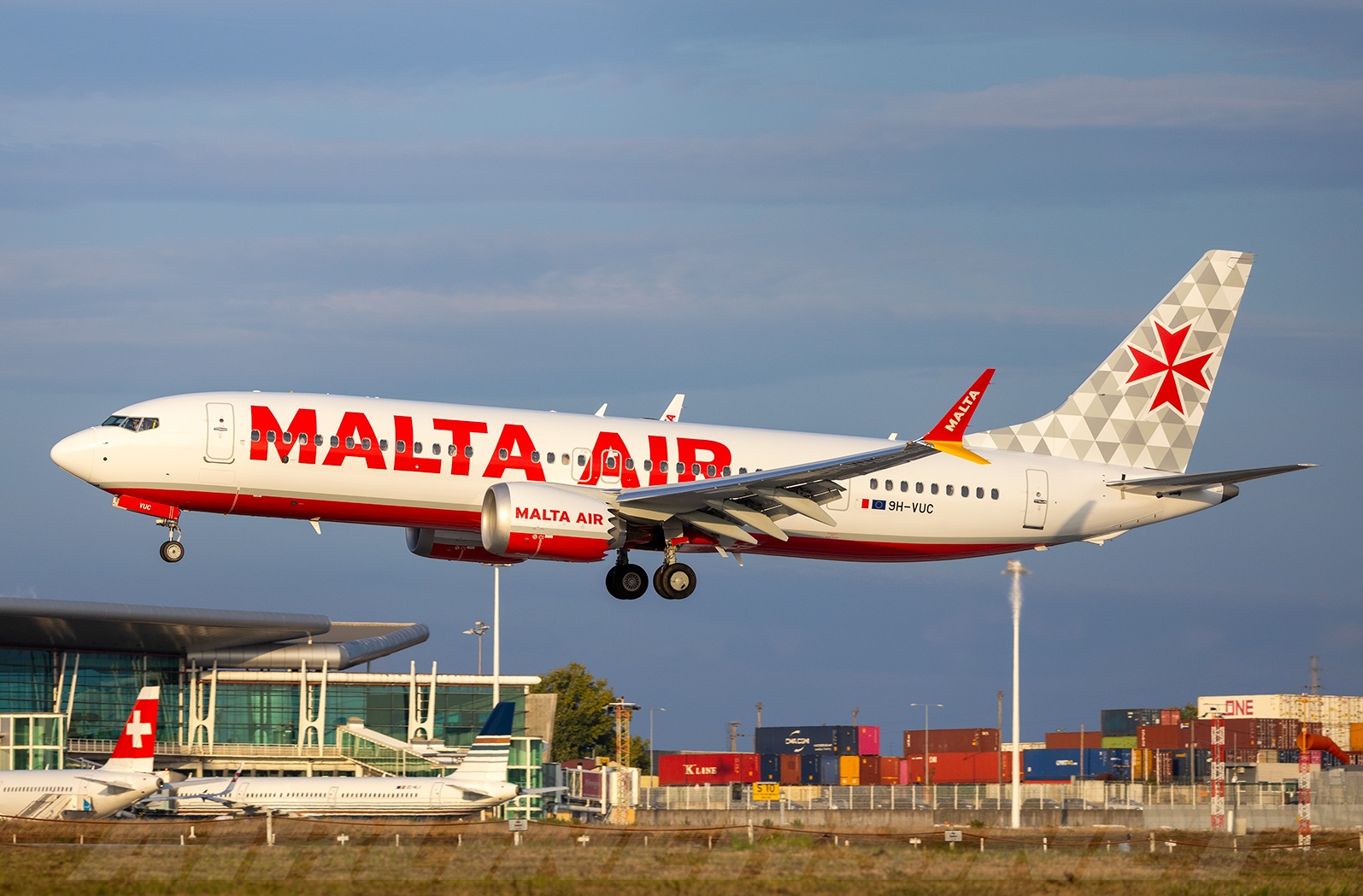
Apr 13th 2023 : A Malta Air Boeing 737-8 MAX operating a Ryanair service from Malta to Riga was forced to return to its departure airport after sustaining a tail strike during takeoff.
The aircraft, registered 9H-VVH and operating flight FR-96757 with 191 people on board, departed Malta International Airport from runway 31. Shortly after rotation, the crew suspected a tail strike and stopped the climb at approximately 6,000 feet. The crew advised air traffic control that no immediate assistance was required and requested time to run checklists, hold to burn off fuel, and return to Malta.
While holding, the crew requested a runway inspection. Airport inspection services initially reported that no debris or damage had been found on the runway. The crew later reiterated that a tail strike was suspected and advised that they would need to remain in the holding pattern for about 90 minutes to reduce landing weight. The aircraft subsequently landed safely back on runway 31 around 100 minutes after departure.
The aircraft remained on the ground for several hours following the return.
Malta’s Bureau of Air Accident Investigation (BAAI) released what it described as a preliminary report, which was later issued as a final report, stating that no further investigation was required and that the case had been discontinued.
According to the BAAI’s summary, the aircraft experienced a tail strike on rotation during takeoff from runway 31. The crew continued the takeoff, climbed to about 5,500 feet, and entered a holding pattern at TIVOR, the initial approach fix for runway 31, to burn fuel before returning to land. The aircraft touched down safely without further incident.
Post-flight inspection found evidence of a tail strike on the aircraft’s tail skid. The tail cartridge was compressed, with the fuse pin intact. The operator reported that no structural damage had been sustained. Additionally, a strike mark matching the aircraft’s paint color was found on the runway centerline just beyond the intersection with taxiway F. The crew stated that the takeoff had been initiated from the intersection with taxiway C.
Weather conditions at the time of departure were reported as CAVOK. The crew stated that ATIS information “V” indicated winds from 230 degrees at 20 knots, with a dry runway. Tower wind during takeoff clearance was reported as 230 degrees at 12 knots.
Despite the BAAI’s decision to discontinue the investigation, it noted that data gathering and analysis had been initiated, with the cockpit voice recorder (CVR) and digital flight data recorder (DFDR) sent for download and review.