




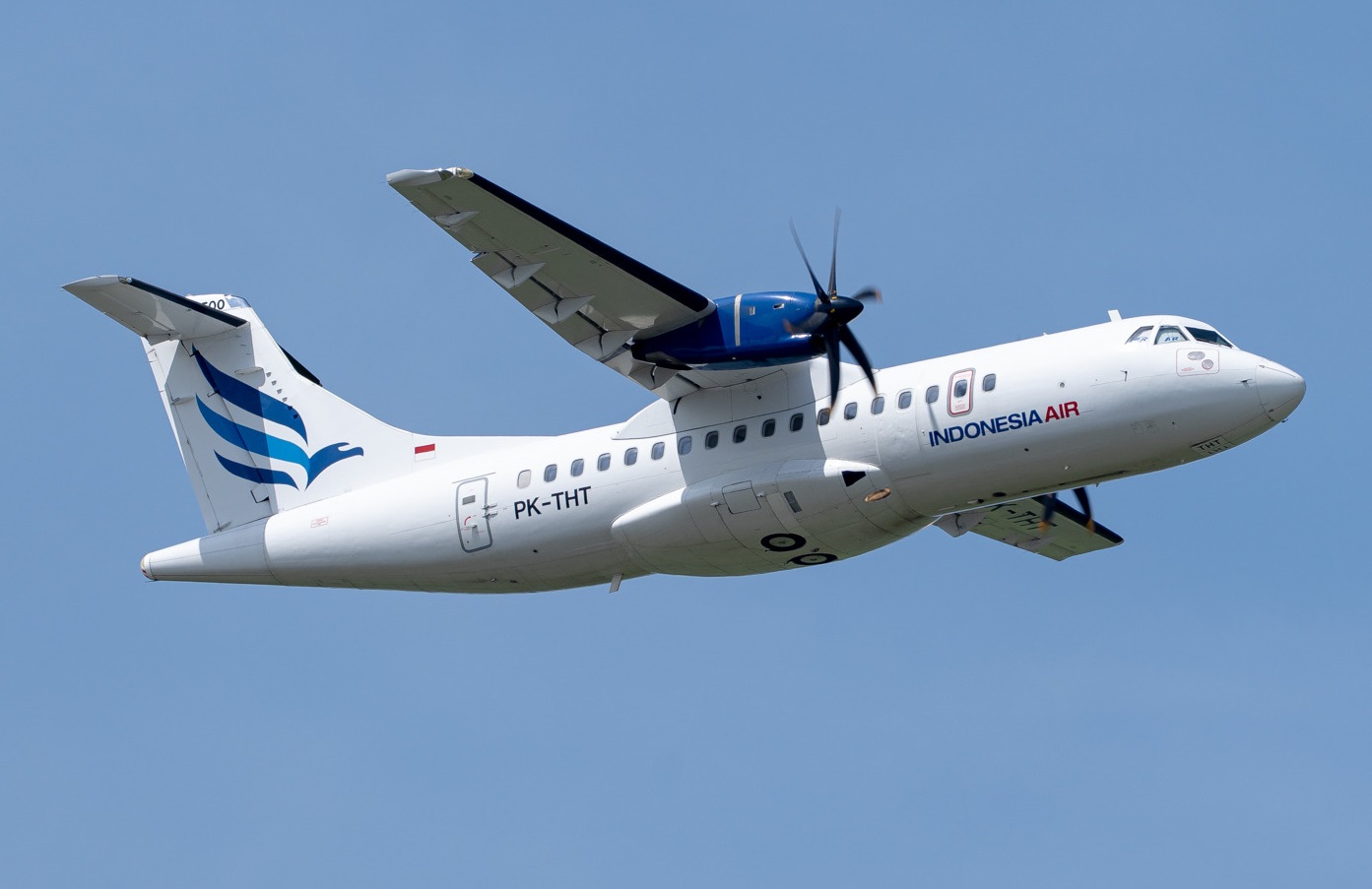
On Jan 17th 2026, an Indonesia Air Transport ATR 42-500, registration PK-THT, crashed into mountainous terrain near Makassar after radar and radio contact were lost during an instrument approach. All 10 people on board — six passengers and four crew — were fatally injured.
The aircraft was operating a charter flight from Yogyakarta to Makassar. According to AirNav Indonesia, the last radar position was recorded at 04°57’08”S / 119°42’54”E at 13:17 local time (06:17Z). The crew had been cleared for an ILS approach to runway 21 at Makassar when air traffic control observed the aircraft was not on the correct approach path and attempted to redirect it. Contact was lost approximately 11 nautical miles northeast of the runway threshold.
Search efforts were immediately hampered by fog and rain over the mountainous terrain. Local residents in the Mount Lapiau area of Leang-Leang reported hearing an explosion around the time of the last contact and later observed smoke on the mountainside. Search and rescue teams focused on the Bantimurung Bulusaraung National Park area. Wreckage was ultimately located on the peak of Mount Bulu Saraung at approximately 5,100 feet above mean sea level.
Recovery operations extended over several days. Debris and victims were retrieved from steep slopes and ravines, with the final bodies recovered by Jan 24th 2026. On Jan 21st, search teams located the aircraft’s tail section and recovered both flight recorders. France’s Bureau d’Enquêtes et d’Analyses (BEA) dispatched investigators to assist Indonesia’s National Transportation Safety Committee (KNKT), alongside participation from the U.S. National Transportation Safety Board.
On Feb 20th 2026, the KNKT released its preliminary report outlining a complex sequence of navigation discrepancies and air traffic control interactions. The Flight Data Recorder showed that the aircraft’s Global Navigation Satellite System operated in degraded mode for much of the flight. Crucially, the aircraft position recorded on board and displayed to the pilots differed significantly from the ADS-B data used by controllers for surveillance. At times during the approach, the difference between the onboard-recorded track and the ground-based ADS-B track reached approximately 15 nautical miles.
During vectoring for the ILS approach, repeated heading confirmations between the crew and ATC revealed inconsistencies between what the pilots believed to be their position and what controllers observed. The aircraft descended to 5,000 feet while entering areas where the minimum safe altitude was as high as 8,000 feet. The surveillance system’s Minimum Safe Altitude Warning did not activate.
At 04:22 UTC, as the aircraft descended through approximately 4,100 feet in mountainous terrain, the Enhanced Ground Proximity Warning System generated “TERRAIN” and repeated “PULL UP” alerts. Moments later, the cockpit voice recorder ceased recording, and the radar target disappeared from the controller’s display.
Mount Bulu Saraung rises to 5,135 feet MSL, directly within the aircraft’s approach environment north of Makassar. The wreckage was found scattered near the summit, indicating a high-energy impact.
The preliminary findings highlight discrepancies between onboard navigation data and ground surveillance displays, complex ATC vectoring amid weather deviations, and the absence of automated terrain conflict alerts at critical moments. The investigation by the KNKT, with international participation under ICAO Annex 13 provisions, continues as authorities work to determine the precise chain of events that led to the controlled flight into terrain.
The tragedy underscores the unforgiving nature of mountainous approaches and the critical importance of accurate positional awareness — both in the cockpit and on the controller’s screen.