

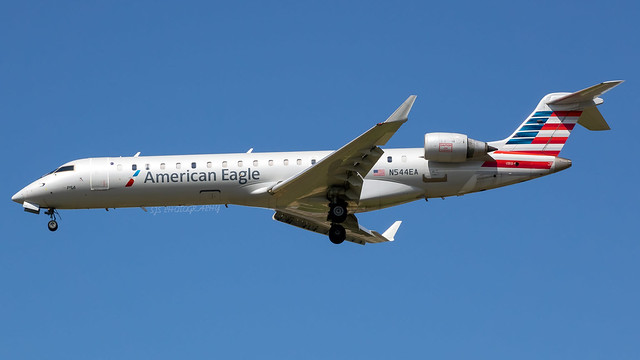
On Jan 29th 2025, a PSA Airlines Bombardier CRJ700, operating as American Airlines flight AA-5342, collided in midair with a U.S. Army Sikorsky UH-60 Black Hawk while on final approach to runway 33 at Ronald Reagan Washington National Airport. All 67 people aboard both aircraft perished.
The CRJ-700, registration N709PS, had departed Wichita with 60 passengers and four crew members. Initially cleared for the runway 01 approach, the crew agreed to switch to runway 33 at the tower’s request and were cleared to land. Descending through approximately 200 feet above ground level about 0.6 nautical miles before the threshold, the aircraft collided with the helicopter, call sign PAT25, which had three military personnel on board.
At 20:46 local time (01:46Z January 30th), both aircraft fell into the Potomac River. A stunned voice was heard on frequency: “Tower, did you see that?” Controllers immediately instructed other aircraft to go around and halted departures. The airport was closed, and aircraft awaiting takeoff were told to return to the apron and shut down.
A massive rescue response began within minutes. Emergency services reported receiving notification from the tower at 20:48 local time. Approximately 300 state and federal personnel responded, supported by helicopters and boats. However, with water temperatures near freezing, officials warned survival time would be extremely limited. By early January 30th, fatalities were confirmed and no survivors were found. The rescue operation was formally transitioned into a recovery effort.
Eyewitnesses described sparks in the night sky, followed by the regional jet rolling inverted before plunging into the river from an estimated height of around 120 feet. Many did not see the helicopter prior to impact.
The Federal Aviation Administration and the National Transportation Safety Board launched investigations, with the NTSB leading. Both aircraft’s flight recorders were recovered from the river in the following days. Data from the CRJ’s flight data recorder showed the aircraft rolling out on final at 344 feet radio altitude seven seconds before impact. One second prior to collision, the crew increased pitch to nine degrees nose-up in an apparent last-second attempt to avoid the helicopter. The final recorded radio altitude was 313 feet. The helicopter’s flight data showed a radio altitude of approximately 278 feet at the time of impact.
Investigators determined that both aircraft had their exterior lights illuminated and that weather conditions were night visual meteorological conditions. The helicopter was conducting a checkride and transitioning along designated helicopter routes over the Potomac. Evidence indicated the helicopter crew may not have received the full instruction to “pass behind” the CRJ due to a stepped-on radio transmission. The CRJ crew received a TCAS “Traffic, Traffic” advisory approximately 19 seconds before impact.
In its final report released on Feb 18th 2026, the NTSB concluded the probable cause of the accident was the FAA’s placement of a helicopter route in close proximity to a runway approach path and its failure to adequately evaluate and mitigate collision risks near National Airport. The Board cited systemic overreliance on visual separation, inadequate review of helicopter routing, failure to act on prior safety recommendations, and shortcomings in safety management processes.
Also causal was the helicopter crew’s ineffective application of visual separation, the tower team’s loss of situational awareness amid high workload, and the Army’s failure to ensure pilots fully understood barometric altimeter tolerances, resulting in the helicopter operating above its published route altitude. Contributing factors included limitations of onboard collision alerting systems, high traffic volume and scheduling pressures at National, incomplete implementation of ADS-B In, insufficient safety management oversight, and poor interagency data sharing.
The NTSB noted that between 2021 and 2024, more than 15,000 close proximity events between commercial aircraft and helicopters occurred in the DCA area with lateral separation under one nautical mile and vertical separation under 400 feet, underscoring longstanding systemic risk.
The collision over the Potomac stands as one of the most devastating U.S. aviation disasters in recent years, reshaping scrutiny of airspace design, helicopter routing near major airports, controller workload, and the limits of see-and-avoid in complex terminal environments.