




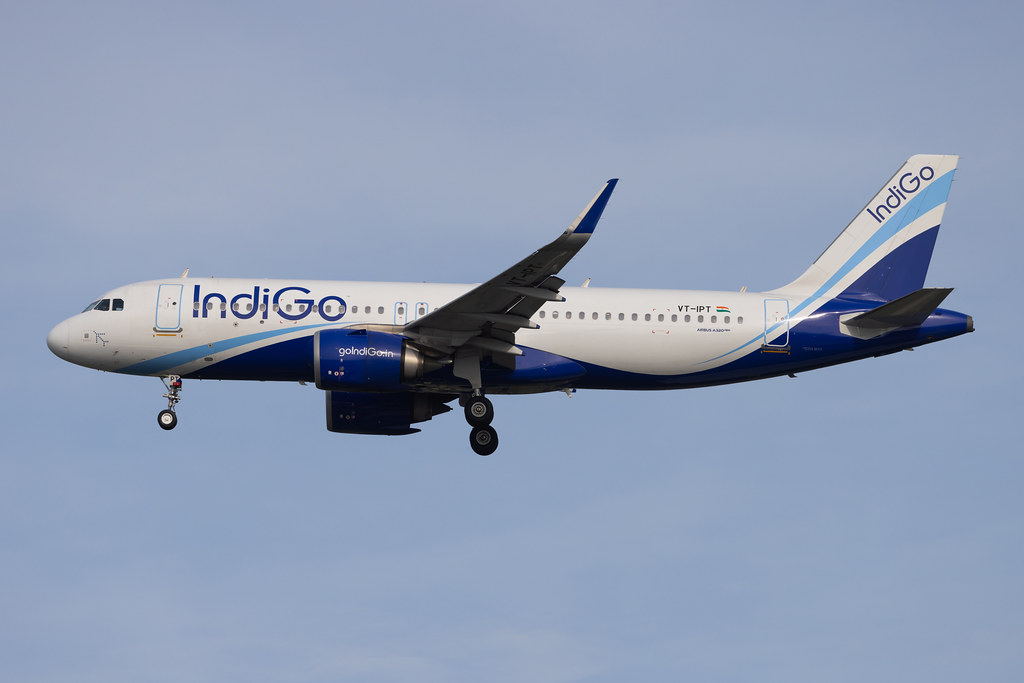
An IndiGo Airbus A320-200N was forced to return to Amritsar shortly after takeoff on Feb 5th, 2023, after suffering a serious engine failure that later investigators traced back to a hidden assembly defect inside the powerplant.
The aircraft, registered VT-ISE and operating flight 6E-5926 from Amritsar to Kolkata, was carrying 122 passengers and six crew members when the incident occurred. Just minutes after departure from runway 34, while climbing through about 4,000 feet, a loud bang was heard as the left-hand Pratt & Whitney PW1127G engine failed. The flight crew immediately stopped the climb, shut down the affected engine, and returned to Amritsar, where the aircraft landed safely on runway 34 roughly 15 minutes after departure.
Passengers were later accommodated on a replacement Airbus A320neo, which reached Kolkata with a delay of approximately two and a half hours. The occurrence aircraft remained grounded in Amritsar for four days before being ferried to Delhi and eventually returned to service.
On Apr 20th, 2023, India’s Aircraft Accident Investigation Bureau (AAIB) classified the event as a serious incident and launched a formal investigation. Nearly three years later, on Jan 20th, 2026, the AAIB released its final report, revealing that the engine failure stemmed from an internal manufacturing and assembly issue dating back to the engine’s last maintenance shop visit.
According to investigators, the probable cause was the fracture of the high-pressure turbine (HPT) second-stage air seal, triggered by axial rubbing between the air seal and the turbine intermediate case (TIC). This contact occurred because the gap between the components had been reduced, ultimately leading to internal object damage, severe rotor imbalance, engine stall, and shutdown.
The report identified a mis-assembled wire seal in the HPT second-stage air seal as a key contributory factor. The incorrect installation likely caused a local bulge in the air seal, reducing the designed clearance and allowing the components to clash under operating conditions. Compounding the problem, investigators found that the original hardware design did not fully account for the maximum possible gap closure during high-temperature operation, increasing the risk of contact.
Post-incident inspections at the engine manufacturer’s facility confirmed that the wire seal had dislodged from its groove—something that should not be possible if correctly installed. This defect led to progressive damage inside the engine, ultimately culminating in the failure experienced during the climb out of Amritsar.
Despite the severity of the malfunction, the flight crew’s response was swift and by the book. Following standard emergency procedures, they shut down the affected engine and returned safely to the departure airport, ensuring no injuries occurred.
The incident has since become a case study in the importance of meticulous maintenance practices and strict adherence to service procedures, particularly on advanced geared turbofan engines, where even minor assembly errors can have major operational consequences.