

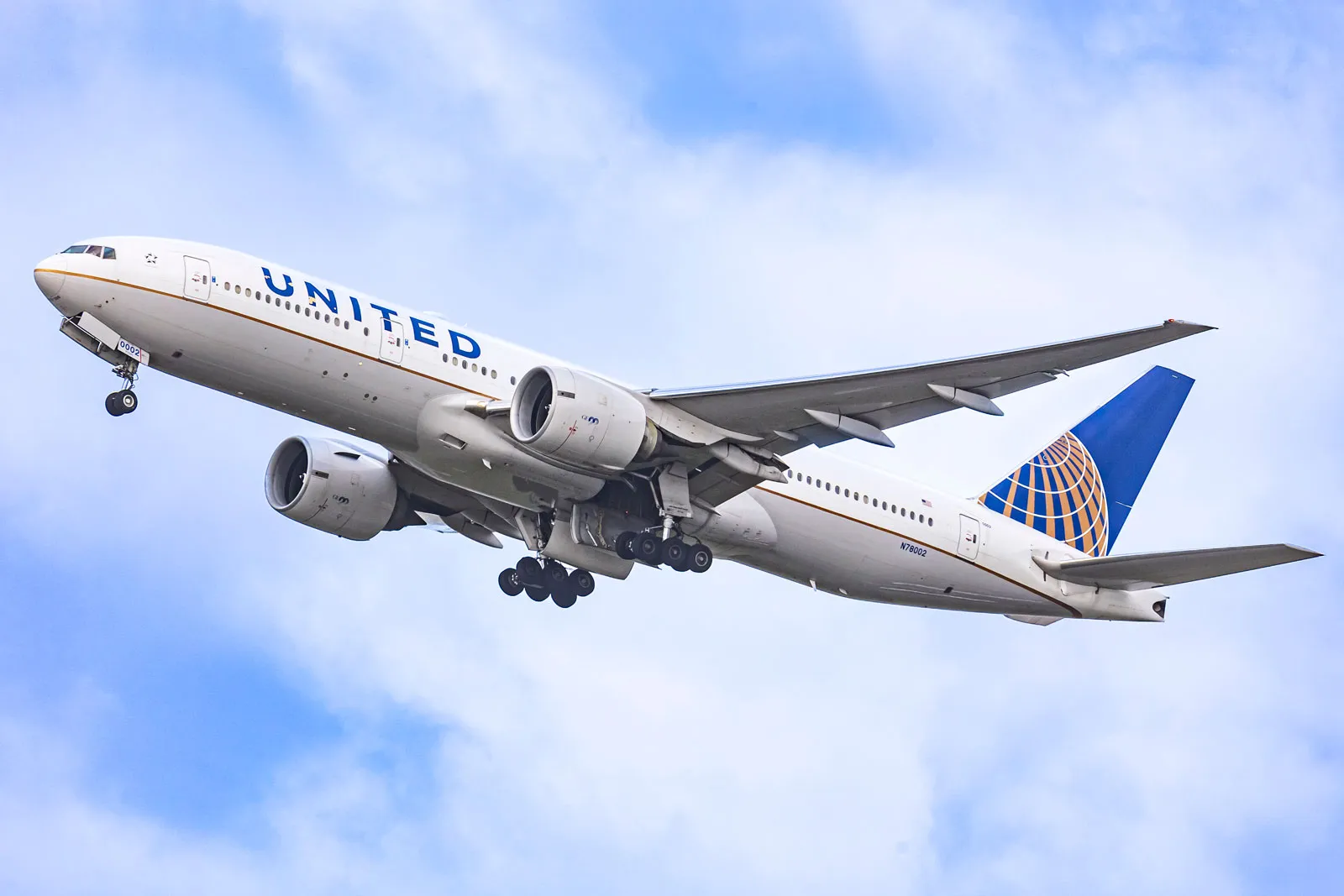
On Feb 10th 2024, a United Airlines Boeing 777-200, registration N788UA, operating flight UA-1890 from Los Angeles, CA to Newark, NJ, encountered severe turbulence enroute, leaving crew members injured despite no prior warning signs along the flight path.
The widebody aircraft was carrying 269 passengers and 11 crew members when the incident occurred. According to flight crew statements later summarized by the NTSB, the departure from Los Angeles was uneventful and the aircraft leveled at FL350 for cruise. The first officer, serving as pilot flying, conducted the approach briefing for Newark and checked multiple weather tools, including the Weather Services International (WSI) application and the Skypath app, neither of which indicated significant turbulence along the planned route. The captain later activated the onboard weather radar in preparation for descent.
As the aircraft descended through approximately FL270, the captain made a public address announcement instructing flight attendants to prepare the cabin for landing and turned on the seatbelt sign. The crew observed an overcast cloud layer ahead but noted no radar returns or reports suggesting turbulence. Air traffic control and dispatch had not relayed any turbulence advisories.
While descending through about FL210 in instrument meteorological conditions, the aircraft suddenly encountered moderate turbulence lasting several seconds. The disturbance was strong enough to toss unsecured items around the flight deck. The captain immediately contacted the cabin crew and was informed of multiple injuries, including a flight attendant who had suffered a head laceration.
The flight crew declared a medical emergency and requested paramedics meet the aircraft upon arrival in Newark. The aircraft continued to Newark and landed safely. In total, two flight attendants sustained serious injuries, including fractures, and a third was diagnosed with a sub-cranial bleed. Initially, the FAA reported that three flight attendants and thirteen passengers received minor injuries, stating: “AIRCRAFT EXPERIENCED SEVERE TURBULENCE INJURYING FLIGHT ATTENDANTS AND PASSENGERS, NEWARK, NJ.”
The NTSB’s preliminary report, released on March 13th 2024, detailed the sequence of events and the weather environment surrounding the encounter. Post-incident analysis revealed a frontal boundary moving eastward across New York State, along with an upper-level jet stream maximum positioned above the accident site. Satellite and radar imagery showed strong convective cells in the vicinity, and the U.S. National Weather Service had issued a SIGMET for embedded thunderstorms with tops reaching FL280 across the region.
Investigative teams were assigned across multiple specialties, including air traffic control, operations, meteorology, survival factors, and flight data analysis. The FAA provided certified ADS-B data and audio recordings. Flight data and cockpit voice recorders were sent to the NTSB’s Vehicle Recorder Laboratory in Washington, D.C. During the week of March 4th, 2024, investigators traveled to Nashua, New Hampshire, to interview personnel at the Boston Air Route Traffic Control Center, which was handling the flight at the time of the encounter.
On Feb 10th 2026, exactly two years after the event, the NTSB released its final report and investigation docket. The Board concluded that the probable cause of the accident was the aircraft’s encounter with an unanticipated localized region of moderate-to-severe turbulence in IMC, associated with strong upper-level wind shear and convective activity.
Contributing to the severity of the outcome, investigators determined, was the failure of air traffic control to disseminate a recently reported moderate turbulence pilot weather report (PIREP). That omission reduced the flight crew’s situational awareness and limited their opportunity to ensure the cabin was fully secured before the turbulence strike.
Though the aircraft landed safely, the event stands as a stark reminder of how rapidly atmospheric conditions can change — and how critical timely information sharing can be in mitigating the risks of high-altitude turbulence.