


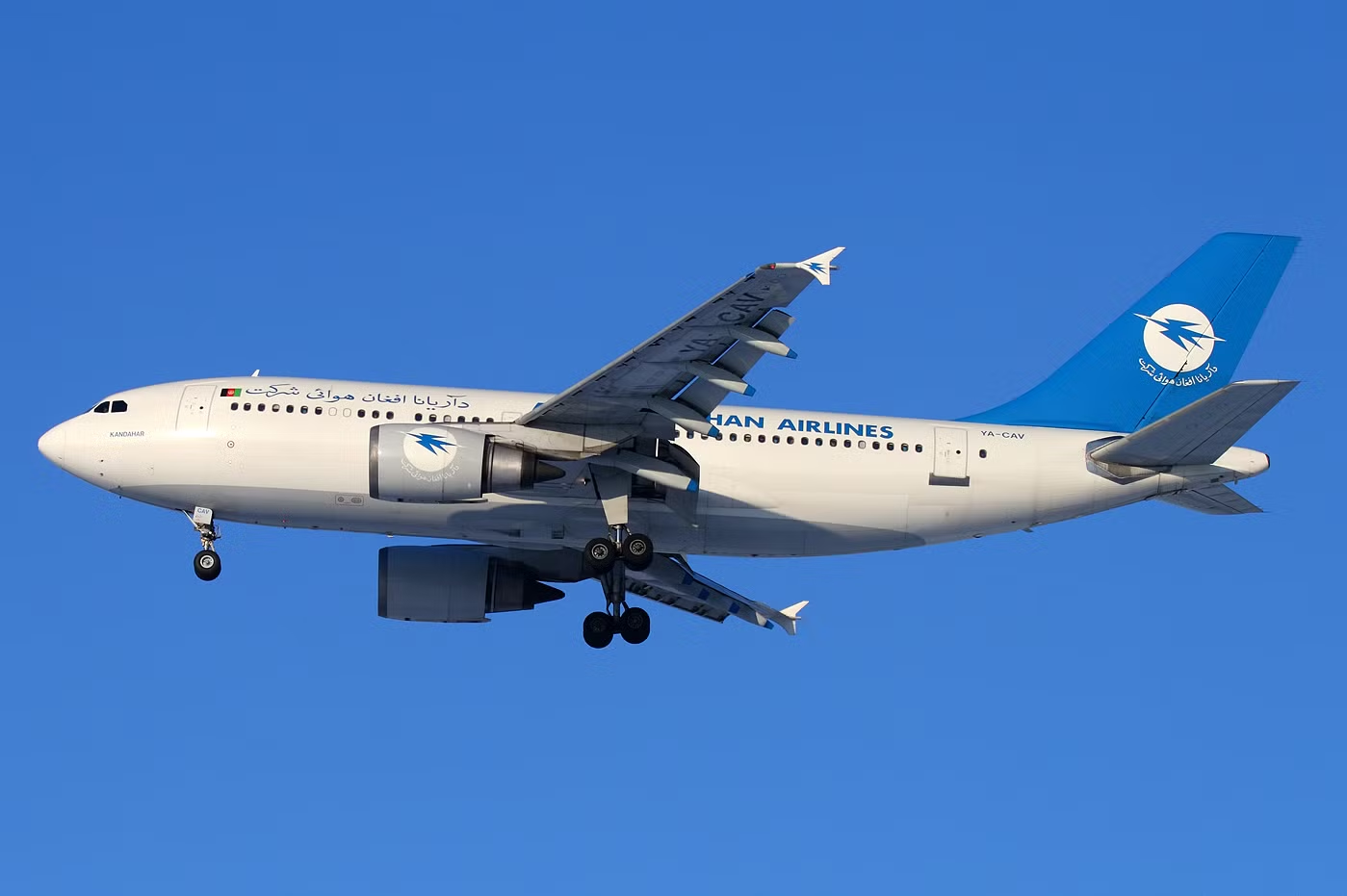
Nov 23rd 2025 : An Ariana Afghan Airlines Airbus A310-300 operating a scheduled international flight from Kabul to Delhi landed on the wrong runway at Indira Gandhi International Airport, prompting a serious incident investigation by Indian aviation authorities.
The aircraft, registration YA-FGF, was performing flight FG-311 from Kabul (Afghanistan) to Delhi (India). Although the crew was cleared to land on runway 29L and correctly read back the landing clearance, the aircraft touched down on the parallel runway 29R, slowed, vacated the runway, and taxied to the apron without further incident. No injuries or damage were reported.
At the time of the occurrence, all other arriving aircraft before and after FG-311 landed normally on runway 29L.
Initial DGCA Response
India’s Directorate General of Civil Aviation (DGCA) opened an investigation shortly after the event, classifying it as a serious incident. According to the DGCA, the flight crew stated that they lost the ILS signal approximately 4 nautical miles from touchdown in poor visibility conditions. The crew reported that the aircraft subsequently turned to the right and continued visually toward the runway visible ahead.
The crew further indicated that air traffic control did not alert them to the deviation from the assigned runway. The DGCA noted that it was not immediately clear whether the aircraft’s ILS system had malfunctioned.
AAIB Preliminary Report
On January 9, 2026, India’s Aircraft Accident Investigation Bureau (AAIB) released its preliminary report, providing a detailed reconstruction of the sequence of events.
According to the AAIB, flight AFG-311 was designated to land on runway 29L under Delhi’s Four Runway Westerly mode of operations. Under this configuration, runway 27 was used for arrivals, runway 28 for departures, runway 29R for departures only, and runway 29L for arrivals.
After initial descent under Delhi Area Control, the aircraft was handed over to Approach Control and radar-vectored for an ILS approach to runway 29L. The flight was subsequently transferred to Tower for the final approach.
AFG-311 reported being established on the localizer for runway 29L at 18 nautical miles from touchdown and contacted Tower at 10 nautical miles while still established on the localizer. The Tower Controller instructed the aircraft to continue the approach to runway 29L, which was read back correctly by the crew.
At approximately 2 nautical miles from touchdown, Tower cleared AFG-311 to land on runway 29L. At the same time, another aircraft, AIC2243, was departing from runway 29R. Despite having received and acknowledged clearance for runway 29L, AFG-311 landed on the unassigned runway 29R at 06:36:22 UTC.
Post-Landing Statements
After vacating runway 29R via Taxiway R, the crew informed Tower that they had lost the ILS signal at about 4 nautical miles from touchdown and, due to poor visibility, were unable to differentiate between runways 29L and 29R.
The AAIB emphasized that runway 29R was not configured for landings at the time of the incident. Its approach lighting, ILS, and PAPI systems were not activated, as the runway was being used exclusively for departures under the prevailing operational mode.
Aircraft Status
Despite the incident, the aircraft was not grounded. Later the same day, the A310 operated its return flight, AFG-312, departing Delhi for Kabul at 10:12 UTC from runway 28.
Ongoing Investigation
The AAIB confirmed that the flight data recorder (FDR) has been successfully retrieved and is undergoing detailed analysis. However, the cockpit voice recorder (CVR) was found to have been overwritten, limiting the availability of recorded crew communications for the investigation.
The inquiry remains ongoing, with investigators focusing on navigational guidance, crew situational awareness, visibility conditions, and air traffic control monitoring during the final approach.