




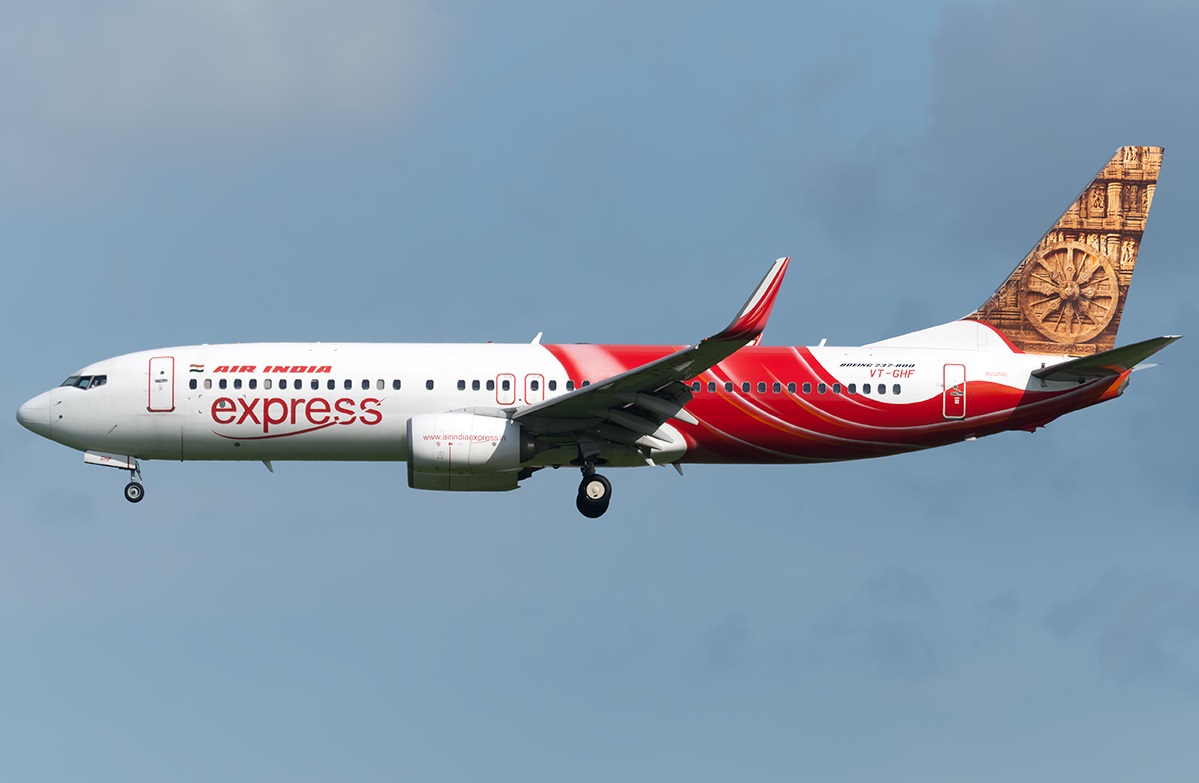
Apr 22nd 2025 : An Air India Express Flight IX331 took off from Khozikode (India) towards its destination Ras al-Khaimah (United Arab Emirates) on Apr 22, 2025.
The aircraft 737-800 with registration VT-AXZ suffered a tail strike while landing on Ras al-Khaimah’s runway 34.
In Jan 2026 the GCAA released their final report reporting the aircraft sustained minor damage and concluding the probable causes of the serious incident were:
A bounce that occurred after an initial firm touchdown (1.7G) at an excessive airspeed and rate of descent, which the flight crew was unable to manage using standard flare inputs.
The excessive energy and firm initial touchdown led to the bounce followed by a hard second touchdown (2.8G) with an increased pitch angle that resulted in a tail strike.
The hard second touchdown occurred because of improper bounce recovery techniques applied by the flight crew.
Contributing Factors
The Air Accident Investigation Sector determines that a contributing factor to the Incident was a breakdown in crew resource management (CRM), as the Commander assumed control at low altitude without the standard PF/PM transfer of control callouts. This resulted in poor coordination, which adversely affected the execution of a stabilized approach and the appropriate flare maneuver.
The GCAA analysed:
The Approach
The disengagement of the autopilot and autothrottle at 955 feet indicated altitude (880 feet radio height), and approximately 2.8 nautical miles from the threshold, is a common point for pilots to assume manual control. At the point of disengagement, the airspeed was 151 knots, 4 knots above the Vref of 147 knots. This is a reasonable speed for this stage of the approach, allowing for some margin. The flaps were set to 30 degrees, a standard landing configuration for the B737-800.
The Aircraft crossed the 50-foot threshold at 154 knots, which is 7 knots above Vref. Both engines were stabilized at N1 58.6%, which was above idle and indicated an excess of energy at this stage of the approach.
The Aircraft remained on the ILS profile (Attachment A). While this indicates accurate lateral and vertical path tracking, the elevated airspeed and engine N1 at the threshold suggest that energy management in the final approach segment was not optimal. Best practice is to cross the threshold at or near Vref, with thrust close to idle, to allow for a timely and controlled flare and touchdown.
The recorded rates of descent in the final moments before touchdown revealed a highly dynamic and unstable vertical profile. The rate of descent increased sharply from approximately 780 feet per minute six seconds before touchdown to 1,200 feet per minute four seconds later. It reached about 1,200 feet per minute below 100 feet radio altitude, exceeding common stabilized criteria. The approach was therefore not stabilized in the final segment. The rate of descent decreased to 330 feet per minute one second prior to touchdown, indicating a late and potentially aggressive flare maneuver to compensate for the preceding high rate of descent. A consistent and controlled rate of descent, typically 700 to 800 feet per minute on a 3-degree glide slope, is a standard stable approach.
The Commander stated that at approximately 70 feet, a high sink rate was perceived, and the control column was pulled back without any adjustment to the thrust levers. The flight data revealed that at about 25 feet radio altitude, the elevator deflected to +12.6 degrees, coincident with the Commander assuming control of the Aircraft. However, as per the CVR recordings, the Commander did not announce the takeover of controls with the standard callout “I have control”, nor did the Copilot acknowledge the transfer by responding “You have control”, indicating a breakdown in crew resource management.
The Touchdown
The thrust levers were retarded to idle as the Aircraft first touched down on both main landing gears (at 1353:06), at 152 knots (which is Vref +5). The vertical load factor was 1.7G, and the pitch angle was 6.3 degrees, which was lower than the typical landing pitch of 7 to 8 degrees for the B737-800. This combination was consistent with a firm touchdown and indicated that the flare maneuver could not sufficiently reduce the rate of descent. At this moment, the flight spoilers began to deploy.
As a result of excessive airspeed and rate of descent in combination with a delayed flare maneuver, the Aircraft bounced for about 1.5 seconds. At that time, the elevator was pulled to a maximum of +13.5 degrees.
The second touchdown was significantly more severe, with a peak vertical load factor of 2.8G that exceeded the 2.2G hard-landing threshold. Pitch attitude at the second touchdown was 9.5 degrees, reflecting an attempt to correct the bounce with increased nose-up input. However, this correction was too late to reduce the touchdown energy. The airspeed had reduced to 146 knots, which was below Vref, indicating some energy deterioration during the bounce. The flight and ground spoilers reached full extension automatically. The load factor and pitch angle were consistent with a tail strike occurrence, which was confirmed by the post-flight inspection. However, no contact marks were found on the tail skid assembly. This indicates that the automatic systems for aerodynamic braking, the spoilers, functioned as designed, effectively destroying lift and increasing drag for braking effectiveness.
Thereafter, the thrust levers were timely and effectively moved to the reverse range while the Aircraft was at an airspeed of 134 knots.
The nosewheel contacted the runway 7 seconds after the second main gears touchdown, which was within a reasonable timeframe for the nose to settle, ensuring directional control during the rollout.
The recorded wind conditions (varying between 336 degrees at 4 knots and 316 degrees at 2.5 knots) were light and did not present a significant crosswind component that would inherently complicate the landing. In general, although the static (ambient) air temperature of 33 degrees Celsius may affect an aircraft performance, the energy management and flight crew control inputs during the Incident flight had more relevance to the hard landing than the environmental conditions.
The Incident was primarily the result of excess energy during the final approach, unstable descent rates in the flare, inadequate touchdown control, and incomplete adherence to crew coordination procedures.