


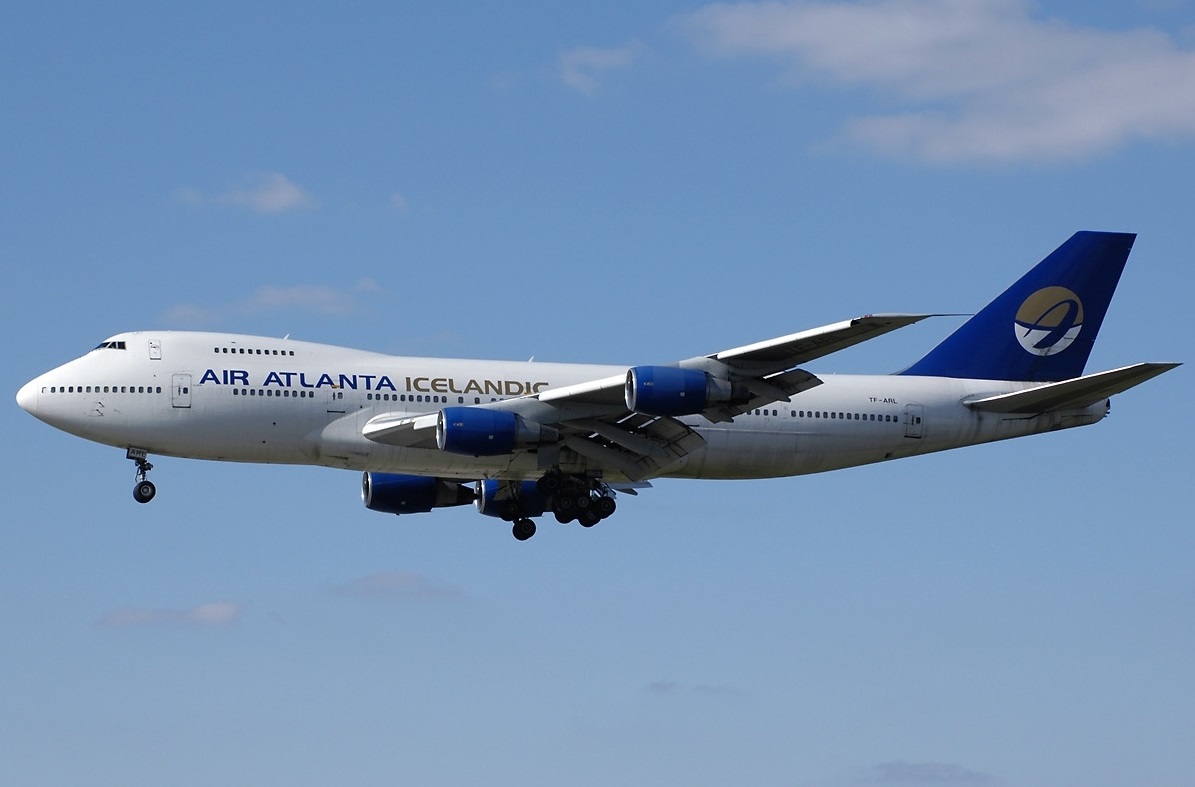
On Nov 29th 2023, an Air Atlanta Icelandic Boeing 747-400 freighter narrowly avoided disaster when it struck its tail on the runway during takeoff from Frankfurt Hahn Airport, yet continued across the Atlantic to the United States before the damage was discovered.
The aircraft, registered TF-AMK and operating flight CC-703 to Greenville, South Carolina, departed runway 21 when its tail briefly contacted the runway surface during rotation. Despite the impact, the crew climbed out normally, initially leveling at FL300 before step-climbing to FL320 and FL340. The flight landed safely in Greenville about 8 hours and 45 minutes later. Only after landing did a post-flight inspection reveal substantial damage to the belly of the fuselage, confirming that a tailstrike had occurred during takeoff.
The aircraft remained grounded in Greenville for nearly two weeks before being ferried to Marana, Arizona, on Dec 12th 2023. After further inspections and repairs, it stayed in storage until Jan 8th 2024, when it eventually returned to service.
Germany’s Federal Bureau of Aircraft Accident Investigation (BFU) opened an investigation and reported in February 2024 that the aircraft had been rotating when the stall warning activated and the stick shaker engaged. The pilot momentarily reduced pitch, regained a safe climb, and continued the flight to destination, unaware at the time of the structural damage.
On Jan 27th 2026, the BFU released its final report, identifying the probable cause as a simple but critical data entry error. The pilot in command had inadvertently entered a takeoff rotation speed (Vr) that was 30 knots too low into the Multipurpose Control and Display Unit. This incorrect value was not detected because the required crosscheck procedures were not followed. As a result, the aircraft rotated too early, reaching a pitch angle of about 15 degrees while still below the speed needed to generate sufficient lift, triggering a stall warning and leading to the tailstrike.
The investigation highlighted ineffective crew resource management at a critical phase of flight. Although both pilots had calculated the takeoff performance, the co-pilot did not verify that the values were correctly entered into the system. The BFU noted that the airline’s standard operating procedures clearly required mutual crosschecking of performance data, a safety barrier that should have caught the error. Given the aircraft’s near-maximum takeoff weight, the unusually low Vr should have been noticeable during the takeoff roll, but the final opportunity to intervene was missed.
The incident ultimately underscored how a single incorrect entry, combined with a breakdown in crosschecking discipline, can bypass multiple layers of safety. While the 747 completed its transatlantic flight without further incident, the investigation serves as a stark reminder that even experienced crews remain vulnerable when standard procedures are not rigorously applied.