
The Learjet 60 Florida Crash: From Manageable Icing to a Catastrophic 32,000-FPM Descent. What Went Wrong?
Nine people were killed when a Bombardier Learjet 60, registered N722BD, crashed near Greenacres, Florida, on November 1, 2026.
The aircraft was flying from Austin, Texas, to North Eleuthera in the Bahamas, cruising at approximately 35,000 feet when the situation reportedly began deteriorating.
The crew initially reported light clear icing and moderate turbulence, describing significant altitude deviations. They requested smoother conditions and subsequently a climb to FL370.
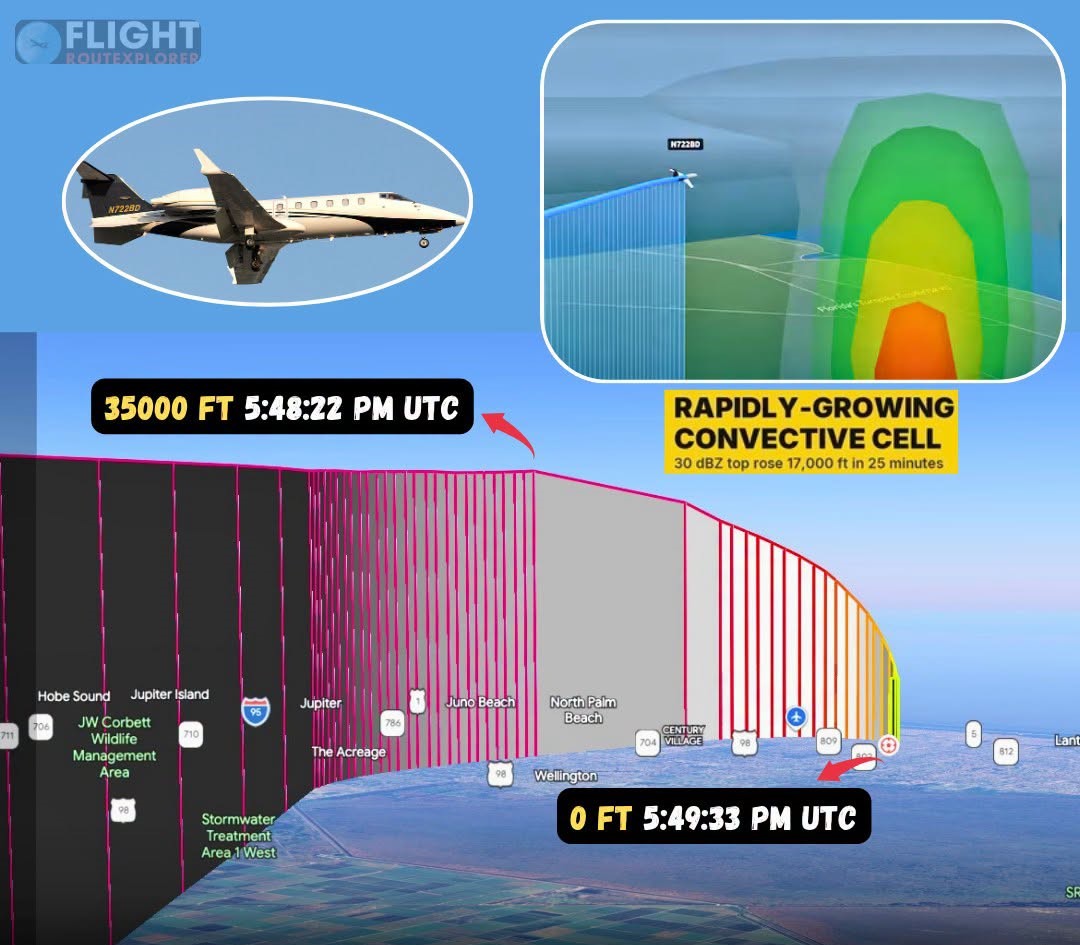
But shortly afterwards, the pilot reported a rapidly increasing descent rate and an overspeed condition. Flight-tracking data later indicated a descent exceeding 32,000 feet per minute before the aircraft crashed.
So, what could have caused such a catastrophic loss of control?
One important investigative lead is a rapidly developing thunderstorm near the aircraft’s final flight path. Preliminary meteorological analysis by MyRadar meteorologist Matthew Cappucci indicated that estimated storm tops increased from approximately 33,000 feet to 48,300 feet in just 20 minutes.
Such powerful convective development can produce severe turbulence, updrafts and downdrafts capable of creating dangerous flight conditions.
Icing is another major concern. Clear ice can increase drag, reduce lift and significantly alter an aircraft’s stall characteristics. Investigators must determine whether icing intensified and whether the Learjet’s ice-protection systems were functioning correctly.
Could turbulence combined with icing have triggered an aerodynamic upset? A stall, uncontrolled roll or steep descent could potentially explain the aircraft’s rapidly deteriorating flight condition. However, the recorded pitch, roll, airspeed and angle-of-attack data will be essential to establishing what actually happened.
The reported overspeed condition raises another critical question. Did the aircraft overspeed because it had already lost control, or did a mechanical malfunction initiate the emergency? Investigators will need to examine the flight controls, autopilot, pitch trim, hydraulic systems, engines and air-data instruments.
The investigation must also examine aircraft maintenance, operational oversight, weather briefings and the crew’s decision-making. There is currently insufficient evidence to assign responsibility to the pilots, operator, maintenance organisation, manufacturer or air traffic control.
The biggest aviation safety lesson is how rapidly deteriorating weather, icing and turbulence can combine to create an extremely dangerous situation at cruising altitude. The NTSB must establish what initiated the emergency, why the aircraft could not recover and whether any technical or operational failures contributed to the tragedy.
These remain preliminary investigative possibilities, not confirmed accident causes. Nine lives were lost, and understanding the sequence of events is essential to preventing another tragedy.