
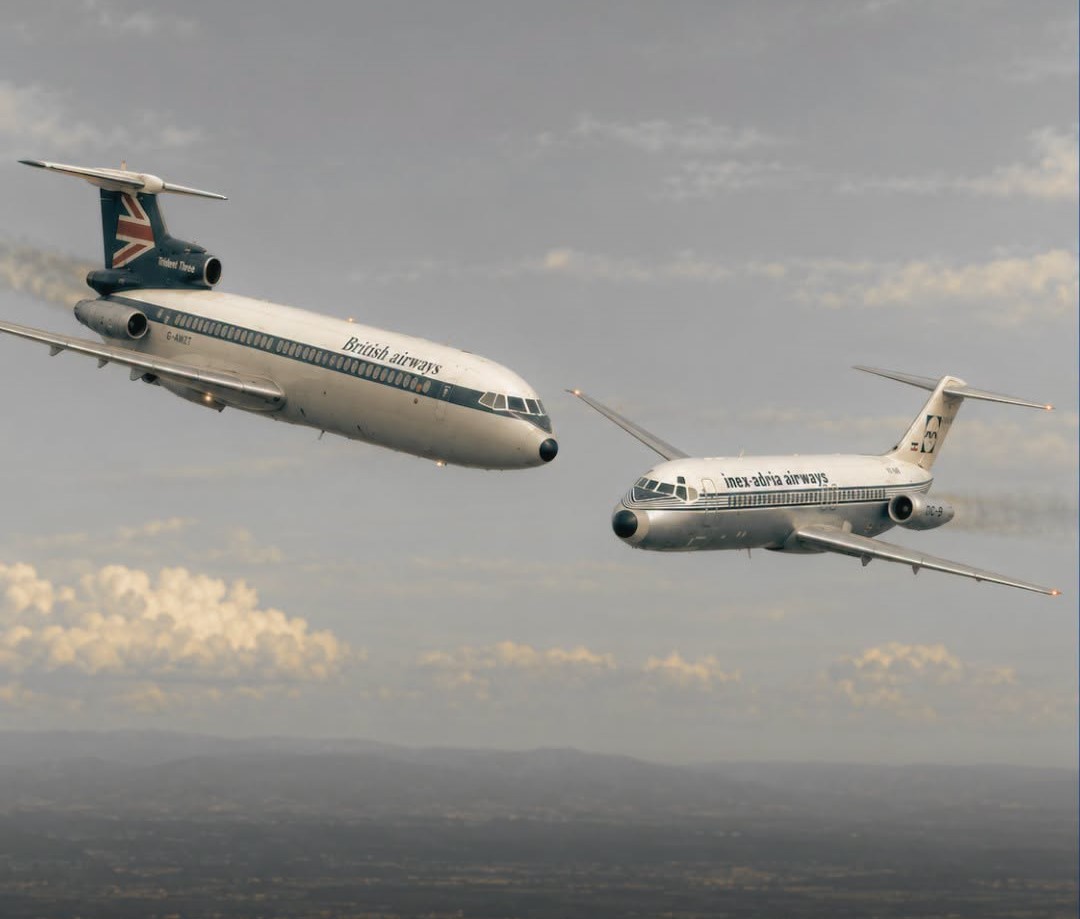
On September 10, 1976, one of Europe’s busiest air corridors became the scene of a catastrophic mid-air collision when British Airways Flight 476 and Inex-Adria Flight 550 collided over Yugoslavia, near Zagreb.
All 176 people aboard the two aircraft were killed, making it the world’s deadliest mid-air collision at the time.
British Airways Flight 476, a Hawker Siddeley Trident 3B carrying 54 passengers and nine crew members, had departed London Heathrow for Istanbul.
At 10:04 UTC, the crew contacted the Zagreb upper-sector controller and reported that they were cruising at Flight Level 330, approximately 33,000 feet. They were told to continue at that altitude and report when passing the Zagreb VOR.
At almost the same time, Inex-Adria Flight 550, a McDonnell Douglas DC-9 carrying 108 passengers and five crew, was climbing from Split toward Cologne.
The aircraft was initially at FL260 and requested a higher altitude. Because FL280 and FL310 were occupied, the middle-sector controller offered FL350. The request required coordination with the upper-sector controller, Gradimir Tasić.
That coordination became the critical point in the disaster. Zagreb’s air traffic control system was handling heavy traffic despite being seriously understaffed and poorly equipped.
Tasić was working the upper sector alone while another controller was away dealing with a staffing issue. After looking at the traffic situation, Tasić authorized the DC-9 to climb.
The DC-9 climbed through FL310 and approached Zagreb. However, its transfer to the upper sector was not handled normally, and its identification on the controller’s screen was compromised. When Flight 550 finally contacted the upper controller at 10:14:04, it reported passing FL325 and then FL327.
Tasić suddenly realized the danger. The DC-9 was climbing directly toward the British Airways Trident, which was already flying at FL330. He ordered Flight 550 to stop climbing, but made the warning in Serbo-Croatian rather than the required international aviation language. The DC-9 levelled off at FL330—the exact altitude occupied by the Trident.
At 10:14:41 UTC, the two aircraft collided over the town of Vrbovec. The DC-9’s left wing sliced through the Trident’s cockpit and forward fuselage. The Trident broke apart after explosive decompression, while the severely damaged DC-9 plunged almost immediately toward the ground. Both aircraft were destroyed and everyone aboard was killed.
The aftermath exposed a chain of failures rather than a simple pilot error. Investigators found serious problems with staffing, coordination, workload, communication and procedures inside Zagreb’s air traffic control system.
Tasić was convicted of criminal negligence in 1977 and sentenced to seven years in prison, but after an appeal by fellow controllers, authorities concluded that he had effectively been made a scapegoat. He was released in November 1978 after serving nearly two years and three months.
The investigation ultimately showed how several seemingly manageable errors had aligned within seconds. Two experienced flight crews were placed on the same altitude, while an overloaded and understaffed control system failed to maintain safe separation.
The Zagreb disaster became a grim reminder that aviation accidents can result not from one dramatic mistake, but from multiple small failures converging at precisely the wrong moment.