


On March 31st 2024, a routine regional flight to one of Spain’s most demanding coastal airports briefly turned into a runway excursion that, while ending without injury or damage, would later prompt a detailed investigation into crosswind landing technique and stabilised approach criteria.
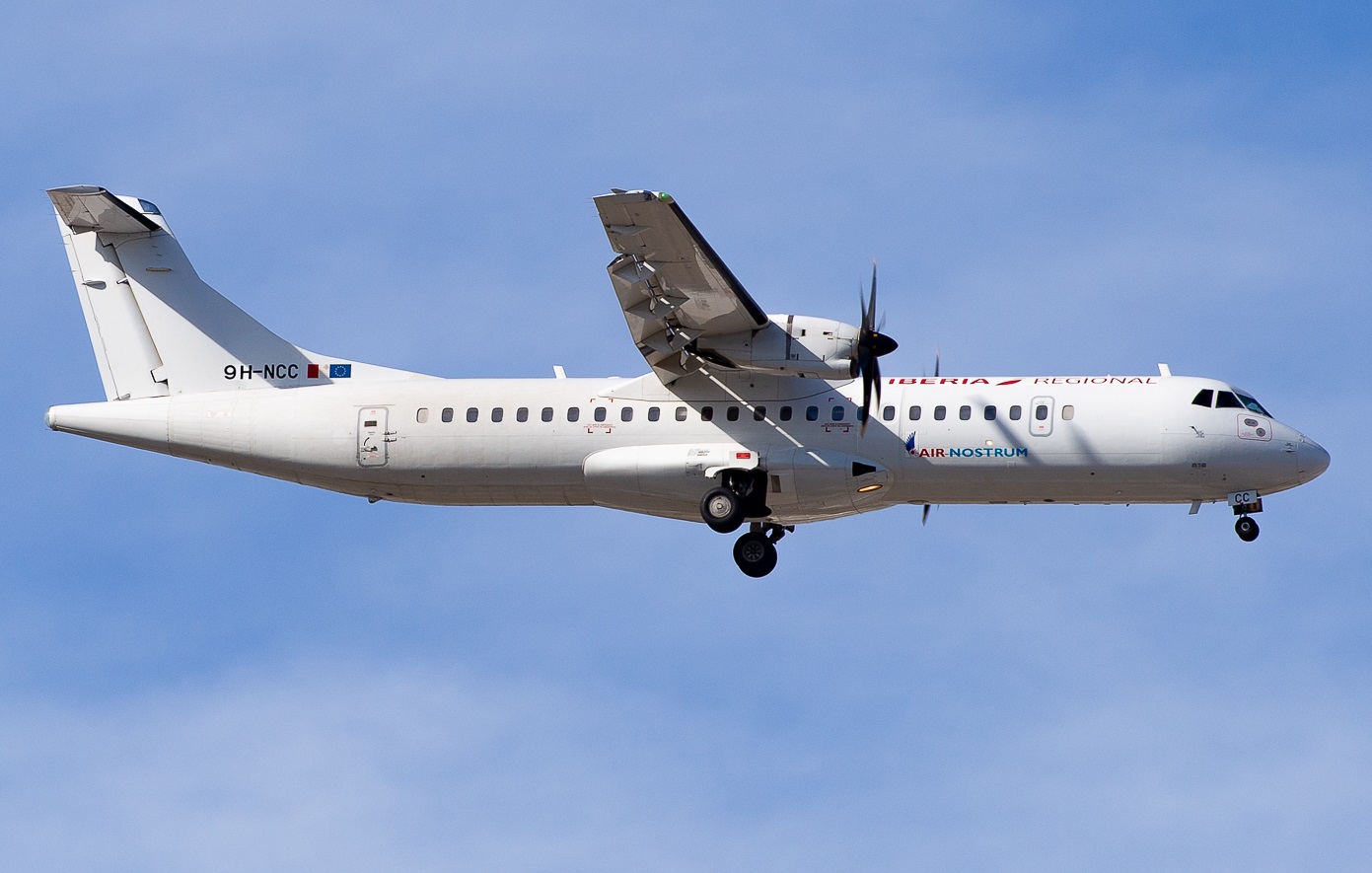
The Mel Air ATR 72-212A, registered 9H-NFR and operating on behalf of Iberia as flight IB-8254, departed Almería for Melilla with 68 passengers and four crew members. At 08:18 local time (06:18 UTC), the aircraft landed on runway 15 at Melilla Airport but veered temporarily off the right edge of the runway before regaining the centerline and continuing its rollout.
According to the Spanish accident investigation authority, CIAIAC, the aircraft momentarily rolled along the dirt area adjacent to the runway before returning to the paved surface. The right landing gear left the pavement for approximately 156 meters, while the left gear briefly departed the surface for about 50 meters. Despite the excursion, the aircraft remained stable, and after 11 seconds it was fully back on the runway centerline. The crew taxied to the end of runway 15, backtracked, and proceeded to the apron. No occupants were injured, and neither the aircraft nor airport facilities sustained damage.
The aircraft remained grounded in Melilla until April 7th 2024, when it repositioned to Valencia. As of April 9th 2024, it was still on the ground there.
In an initial update released on April 12th 2024, the CIAIAC confirmed that the aircraft had been unable to maintain its trajectory during the landing roll, leading to a brief departure from the runway. The final report, published on February 23rd 2026, concluded that the primary cause of the excursion was a momentary loss of directional control during the landing run, triggered by inadequate management of flight controls in the presence of a crosswind with variable gusts. Insufficient corrective action to recover the runway axis was cited as a contributing factor.
The approach itself contained early warning signs. The crew conducted a visual approach to runway 15, disengaging the autopilot around 4.5 nautical miles from the displaced threshold. The approach path at Melilla is steeper than standard, guided by a 4.38° PAPI rather than the usual 3°, and the environment is known for turbulence due to surrounding terrain, including the nearby Gurugú mountain. The crew had discussed crosswind and terrain considerations during briefing, and the captain—serving as instructor—considered the first officer competent, with prior uneventful crosswind landings at Melilla earlier that week.
However, flight data revealed that during the final 500 feet, the indicated airspeed increased to 140 knots, averaging 133 knots—seven knots above the operator’s stabilised approach upper limit of VREF+20 knots. For the landing weight, the reference speed (VMBH30) was 106 knots, and the selected approach speed was 116 knots. The maximum permissible stabilised approach speed should have been 126 knots, yet this exceedance was neither identified nor called out. There was no recorded stabilised/unstabilised approach call at 1000 or 500 feet, as required by procedures. According to the operations manual, this should have prompted a go-around.
Touchdown occurred approximately 320 meters beyond the displaced threshold, slightly beyond the normal touchdown zone, at 112 knots with reverse thrust applied. The landing was described by the captain as soft, but investigators determined it was effectively a long landing caused by excess approach speed. Again, no go-around was initiated.
In the first seconds after touchdown, control inputs followed manufacturer guidance, with roll into wind and rudder inputs to maintain alignment. But three seconds into the rollout, the first officer applied right rudder and altered control wheel correction. Within five seconds of touchdown, the aircraft began drifting rapidly to the right. A weathervaning effect—where the aircraft naturally turns into the wind—developed. Although corrective rudder was later applied to the left with increasing force, the aircraft’s heading shifted from 145° to 166°, and lateral acceleration peaked at 0.39 g before being countered. At 06:18:46 UTC, with speed reduced to 41 knots, the aircraft was fully back on the runway centerline.
Investigators concluded that pedal corrections were not applied smoothly or effectively enough to counter the crosswind and prevent the weathervane effect. According to the aircraft’s flight crew operating manual, in strong crosswinds it may be necessary to maintain crossed controls after touchdown to prevent the upwind wing from lifting and to resist directional drift. In this case, the corrective technique was judged inadequate.
Weather analysis showed complex conditions typical of Melilla, an autonomous Spanish city on the North African coast bordering Morocco. The airport is known for turbulent airflow due to orography and coastal influences. Although the approach was initially planned for runway 33, ATC advised landing on runway 15 due to prevailing winds. The crew re-briefed in time. A SIGMET had warned of severe mountain wave activity in the Casablanca FIR affecting Melilla. While windsocks indicated a south-westerly wind at landing, slight directional differences were recorded between measurement units at each runway end. However, investigators could not conclusively verify a significant wind shift at the precise touchdown point.
The first officer later stated he felt the wind changing direction during rollout, prompting his control adjustment. Neither the flight data recorder nor cockpit voice recorder confirmed a definitive wind shift. Importantly, no passengers or cabin crew reported sensing any abnormal event—there were no sudden jolts, vibrations, or loud noises.
The CIAIAC ultimately determined that while the meteorological environment was challenging, the decisive factor was flight control management during rollout. The event underscored the critical importance of strict adherence to stabilised approach criteria and precise crosswind landing technique—particularly at demanding airfields like Melilla—where small deviations can quickly compound.
In the end, what could have escalated into a far more serious incident instead became a case study in how marginal speed exceedances, missed procedural callouts, and momentary control lapses can align, even on a landing that initially feels routine.