




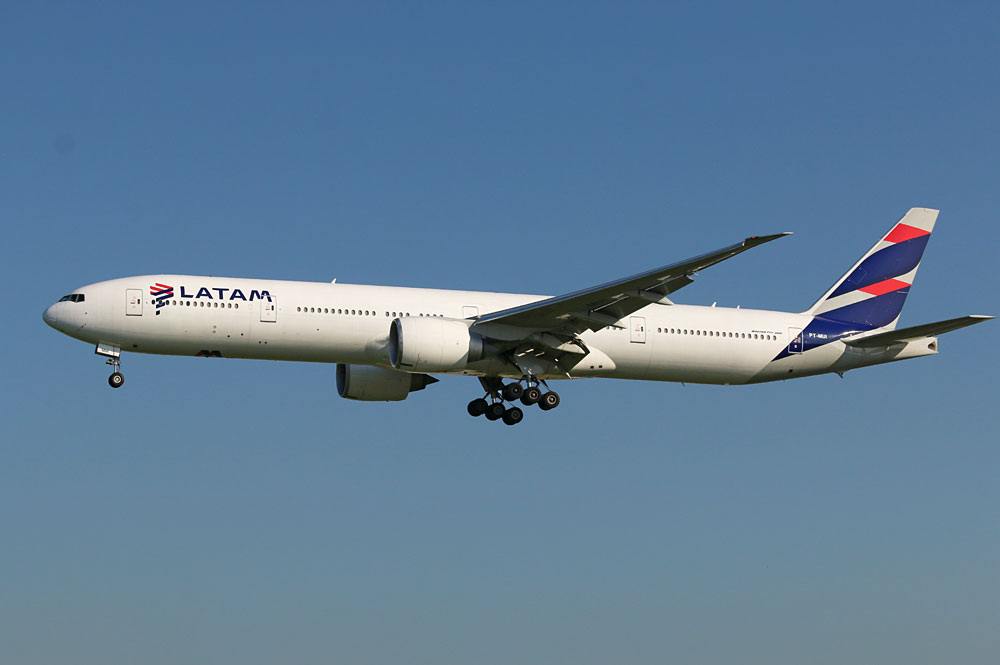
On Jul 9th, 2024, a LATAM Brasil Boeing 777-300, registration PT-MUG, operating flight LA-8073 from Milan Malpensa (Italy) to São Paulo Guarulhos (Brazil) with 398 people on board, suffered a dramatic tail strike during takeoff that left long scars on the runway and triggered an extensive international safety investigation.
The aircraft departed runway 35L at Malpensa but struck its tail on the runway surface during rotation. Despite the impact, the crew continued the climb to safety, stopping at 5,000 feet before entering a holding pattern. The aircraft later climbed to 6,000 feet to dump fuel, then returned safely to Milan, landing on runway 35R about 75 minutes after departure.
Italy’s accident investigation authority ANSV quickly opened a safety investigation, classifying the event as a serious incident. Investigators confirmed that during the takeoff roll the aircraft’s tail scraped the asphalt for more than 720 meters, leaving furrows up to 6 cm deep. Parts detached from the aircraft were later found on the runway during inspections.
According to flight data, the Boeing 777 began its takeoff roll at 11:25:59Z. Rotation started at 153 knots, but within seconds, at a pitch angle of 8.2 degrees, the tail strike warning activated. The aircraft lifted off at 180 knots, and the cockpit voice recorder captured the audible tail strike alert moments later. The control tower also visually observed the tail strike and immediately informed the crew.
Once airborne, the crew entered a hold near Malpensa, declared PAN PAN PAN, and requested fuel dumping. Over approximately 32 minutes, the aircraft dumped about 72,000 kg of fuel while flying multiple holding patterns west of the airport at 6,000 feet. After completing the procedure, the aircraft performed an ILS approach and landed safely with a reduced gross weight.
The investigation revealed significant damage to the tail skid, a drain mast, and the tail strike sensor. Subsequent performance analysis showed a critical discrepancy: the takeoff performance data entered into the flight management system was calculated for a weight far lower than the aircraft’s actual takeoff weight. As a result, the rotation speed was significantly too low for the real conditions.
In its final report released on Feb 6th, 2026, ANSV concluded that the probable cause of the tail strike was premature rotation at an insufficient speed, stemming from incorrect takeoff performance data entered into the FMS. Contributing factors included deviation from standard procedures, failure by the flight crew to properly interpret a “V SPEEDS UNAVAILABLE” message, and the absence of automatic onboard weight and takeoff performance monitoring systems, which are not currently mandated by regulation.
The incident stands as a stark reminder of how performance calculation errors in heavy long-haul aircraft can rapidly escalate into serious safety events, even under benign weather conditions, and has renewed discussion within the industry about the value of automated weight and performance monitoring systems in preventing similar occurrences.