





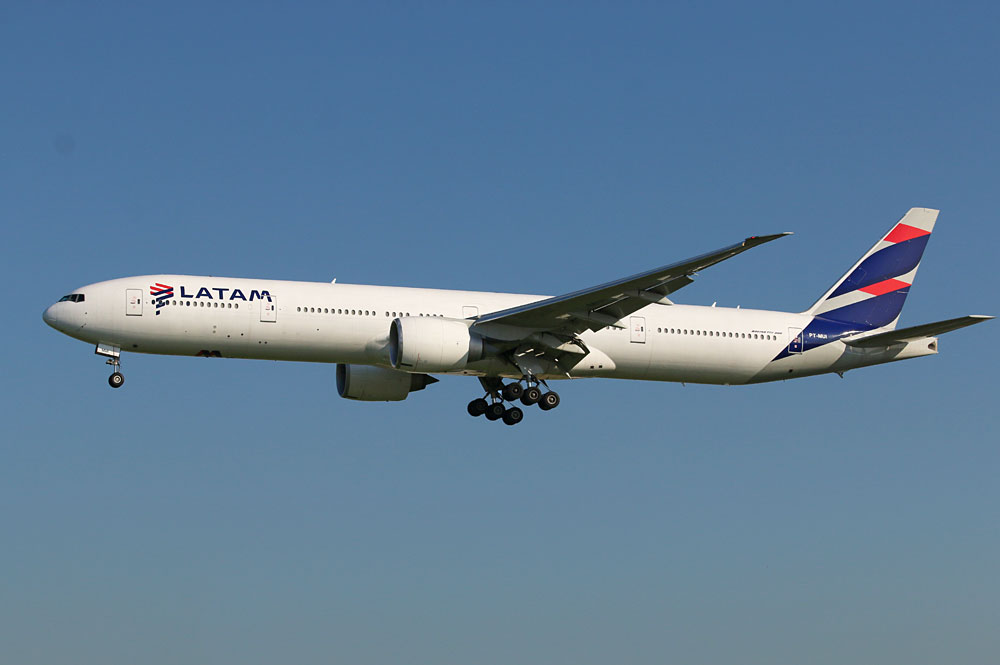
On Jul 9th, 2024, a LATAM Brasil Boeing 777-300, registration PT-MUG, operating flight LA-8073 from Milan Malpensa (Italy) to São Paulo Guarulhos (Brazil) with 398 people on board, struck its tail on the runway during rotation shortly after departure from runway 35L.
Despite the impact, the widebody climbed away safely and stopped its climb at 5,000 feet, later holding at 6,000 feet while the crew worked through non-normal procedures. With damage suspected and the aircraft overweight for landing, the crew initiated fuel dumping, then returned to Malpensa for a safe landing on runway 35R about 75 minutes after departure.
Italy’s ANSV opened a safety investigation, coordinating with Brazilian and U.S. authorities in line with ICAO Annex 13. Early inspections revealed significant runway contact, and later documentation confirmed a 723-meter furrow in the asphalt, with depths reaching up to 6 cm, offset progressively from the centerline.
Flight data showed the aircraft began its takeoff roll at 11:25:59, with rotation initiated at 153 kt. Tail Strike Indicator signals activated at 11:26:42 as pitch reached 8.2°, and the aircraft lifted off moments later. The cockpit voice recorder captured an audible tail-strike warning, followed by a tower call confirming the strike. Once airborne, the crew declared PAN, PAN, PAN, requested time to assess, and coordinated fuel dumping.
Over roughly 32 minutes, approximately 72,000 kg of fuel was jettisoned during seven holding patterns at 6,000 feet before the aircraft executed an ILS Z approach and landed at 12:36, touching down at a gross weight of about 249.2 tons. Damage was later identified to the tail skid, a drain mast, and the tail-strike sensor.
In its final report released on Feb 6th, 2026, ANSV concluded the probable cause was a rotation at a speed significantly lower than required for the aircraft’s actual weight, after takeoff performance data entered into the FMS were calculated for a much lower weight. Contributing factors included deviations from standard procedures requiring independent performance calculations by each pilot, misunderstanding of a “V SPEEDS UNAVAILABLE” message, and the absence of onboard weighing and takeoff performance monitoring systems, which are not currently mandated.
The event underscores how performance data integrity and procedural discipline are critical on high-gross-weight departures—especially on long-haul widebody operations—where even small discrepancies can leave a very long mark on the runway.